

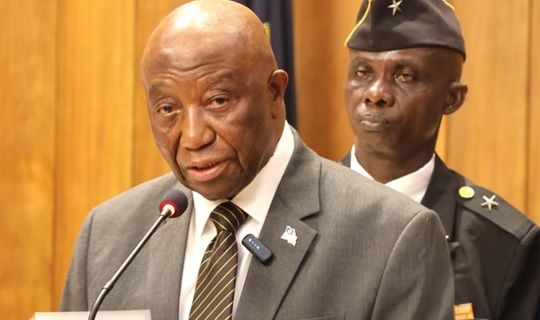
Liberian President Joseph Boakai warns West Africa faces a worsening security landscape driven in part by Islamist militant activity and other transnational threats, and called for immediate, coordinated regional action to prevent a broader collapse of stability.
Speaking at the High-Level Consultative Conference on Regional Cooperation and Security in Accra on January 30, 2026, Boakai said the recent situation in Niger showed how quickly insecurity can spread across borders.
“None of us can be peaceful and stable if any of us is insecure and terrorized. Liberia is not safe if an inch of Ghana is in terror,” he said, urging leaders to move beyond rhetoric to collective measures.
Boakai described the Niger developments as a “rude awakening and a crude reminder” of the interconnected risks facing the region.
He listed a wide range of security drivers—including terrorism and violent extremism, transnational crime, maritime insecurity, arms proliferation, illicit mining, human trafficking, cybercrime, drug abuse and youth unemployment—and warned that non-state actors are exploiting governance gaps and lawlessness to undermine peace.
As a nonpermanent member of the United Nations Security Council, Boakai said Liberia would press for a regional approach to peacebuilding and counterterrorism.
He welcomed an outcome document produced by intelligence chiefs and ministers at the conference and said Liberia was ready to help implement recommendations aimed at dismantling cross border networks that sustain conflict and terrorism.
Boakai drew on Liberia’s own history of violent conflict to stress the human and economic costs of failing to act.
He appealed for renewed activation of regional mechanisms to promote economic growth, job creation and skills training as part of a broader strategy to address the socioeconomic drivers of insecurity.
“We are here because there is only one option: our collective survival and the survival of our people,” he said.
The president called for investment in modern security architecture and improved cooperation among states to match technological advances used by criminal and extremist networks.
He noted that increasing global polarization, economic disruption and political uncertainty were compounding fragility in smaller and developing states, making multilateralism and regional solidarity more important than ever.
Boakai thanked Ghanaian President John Dramani Mahama for convening the meeting and expressed Liberia’s solidarity with the people of Niger.
He said Liberia would continue to work with regional partners and international institutions to bolster prevention, intelligence sharing, and development initiatives intended to reduce the appeal of extremist groups and restore stability across West Africa.

