

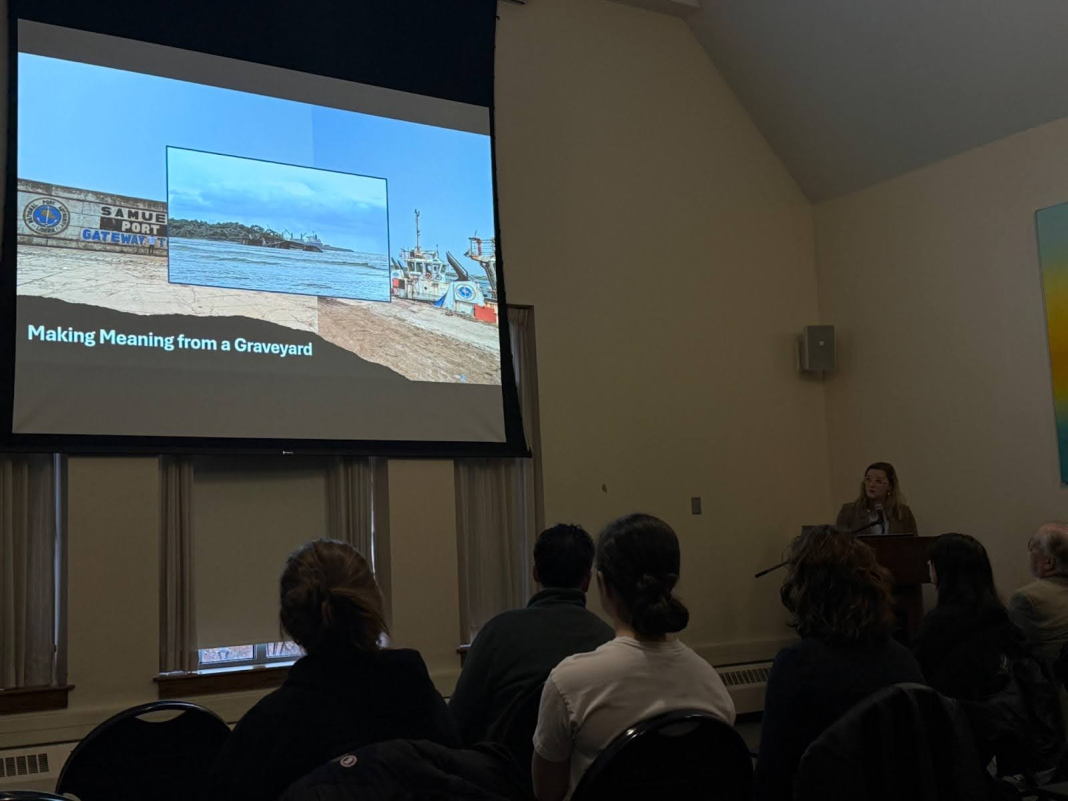
On Feb. 26, in the Rittenberg Lounge at Mather Hall, Dr. Megan Crutcher, the Ann Plato Postdoctoral Fellow in History, presented their research on ghost ships and abandoned shipwrecks in Liberia, West Africa.
Dr. Crutcher opened their presentation, called a “sea chart,” with an overview of maritime archaeology, defining it as a broad field that studies how humans interact with oceans, lakes and rivers. They explained two key branches: nautical archaeology, which focuses on ships and boats, and underwater archaeology, which is conducted underwater. They emphasized that “both nautical and underwater archeology can be conducted on land by non-divers.”
Dr. Crutcher highlighted the importance of maritime archaeology, noting that waterways have long been crucial for moving people, goods, and ideas. “When we consider the movement of people, things, and ideas, a lot of the time this has happened through watery pathways in human history,” Dr. Crutcher said.
The main research question guiding the talk was: “What happens to ships when they die?” Dr. Crutcher explained that popular culture often imagines a ghost ship as unmanned vessels left at sea, similar to the Black Pearl from Pirates of the Caribbean directed by Gore Verbinski. In reality, they noted, most ships are intentionally abandoned once they are no longer useful. These vessels are known as “hulks.”
Areas with multiple abandoned ships are called “ship graveyards.” Dr. Crutcher explained that these sites can be primary deposits, where ships remain where they were first left, or secondary deposits, where ships are moved later. As an example, they referenced a ship graveyard in the Potomac River in the United States.
The presentation then turned to Liberia, a country with a long maritime history but little prior maritime archeological research. Dr. Crutcher noted that “Liberia’s coastline is littered with abandoned shipwrecks, hulks and unintentional shipwrecks,” dating from the fifteenth century to the present day. Historically, much of Liberia’s population has lived near the coast, relying on maritime trade, canoe transports and shipboard labor.
The main case study centered around the wreck of Optimus, which was a large cargo ship that sank in the Port of Greenville in southeastern Liberia during the First Liberian Civil War in the early 1990s. Rather than conducting underwater excavations, Dr. Crutcher’s team studied the wreck through surface observation, satellite imagery, archival research and interviews with local residents. “This shipwreck is a very monstrous reminder to a lot of Liberians of the devastation of the civil wars,” Crutcher stated.
Dr. Crutcher described how community members understand the wreck through vivid metaphors, calling it a skeleton, a ghost, and a zombie. “It’s no longer alive, it’s no longer used, but it’s not quite dead either” they explained. These stories, Dr. Crutcher argued, reveal how people process violence and loss in a county with few formal memorials to the war.
Concluding the talk, Dr. Crutcher emphasized that the wreck of Optimus is not only a reminder of the conflict but also a site of possibility: “Under the layers of rust, salt, and vegetation, there is possibility,” they said, pointing to the reopening of the Port of Greenville and the continued importance of maritime labor in Liberia’s recovery.
- Trinity Tripod

