

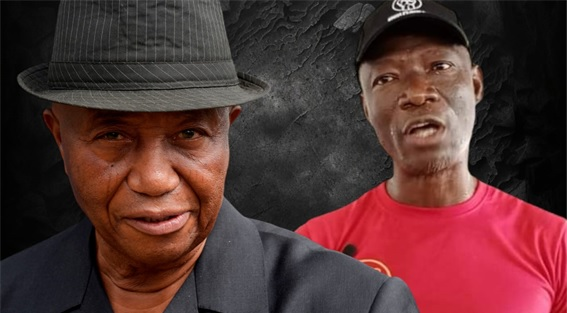
By Festus Poquie
President Joseph Nyuma Boakai faces a thorny legal and political choice after the House of Representatives moved to expel firebrand legislator Yekeh Kolubah and recommended criminal investigation over comments the chamber said threatened national security.
The probe request — and a resolution urging the Ministry of Justice to investigate Kolubah’s statements tied to the volatile Liberia–Guinea border situation has exposed sharp divisions inside the governing Unity Party Alliance and put Liberia’s separation of powers under strain.
Kolubah, once a key campaign operative for Boakai in 2023 known for vitriolic attacks on former President George Weah, was expelled in a plenary session that lawmakers and Speaker’s office say secured the 49 votes the House’s rules require.
But the process is mired in procedural dispute: Kolubah’s legal team has filed a challenge with the Supreme Court arguing the House did not obtain the constitutionally required signatures and that due process norms were breached — a ruling that could derail any referral to prosecutors.

Legal pathway to treason — what the law requires
Under Liberia’s constitutional and criminal framework, charges of treason and related national security offenses carry heavy burdens.
Liberian law — reflecting common constitutional models — criminalizes acts such as levying war against the Republic, adhering to or giving aid and comfort to enemies, or conspiring to overthrow the government.
The Constitution also empowers each chamber of the Legislature to discipline members, but criminal liability is established by statute and decided by independent courts.
Key legal requirements that would confront any treason or national security prosecution include:
- Mens rea (intent): Prosecutors must prove Kolubah acted with intent to betray the Republic or to materially further hostile actors’ aims. Broad or intemperate public speech, without evidence of a deliberate plan to aid enemies, generally does not satisfy the men’s real element for treason.
- Overt act: Most treason statutes require proof of an overt act that substantively advances the treasonous objective — mere words or expressions of opinion are often insufficient absent corroborating conduct (travel, communications with foreign actors, transfer of funds, etc.).
- Evidentiary standard at trial: Criminal charges must be proved beyond a reasonable doubt in court. Prosecutors would need admissible evidence linking Kolubah’s statements to concrete assistance to a hostile party or an intent to subvert the state.
- Corroboration and national security sensitivity: Given the high stakes, courts expect corroboration of claims that a public figure’s speech constituted criminal conduct. Evidence sourced from sensitive intelligence may require vetting and could be subject to classified evidence procedures.
Legal experts in Monrovia say the bar for treason is deliberately high to protect political expression and avoid criminalizing sharp political rhetoric.
“A legislature can censure or expel, but converting heated speech into treason requires factual proof of intent and an overt act that goes beyond public remarks,” said a constitutional lawyer who declined to be named.
“Prosecutors must be able to point to acts or communications that materially aided a hostile actor.”
Procedural and political obstacles
Even if the House’s resolution is sustained, a referral to the Ministry of Justice would not automatically yield charges. The Ministry, which operates with prosecutorial discretion and must observe evidentiary norms, would weigh whether the claims could survive judicial scrutiny — a calculation that takes into account admissible evidence, the pending Supreme Court challenge over the expulsion, and the political consequences of prosecuting a polarizing former ally.
For President Boakai the decision carries tradeoffs. Pressing for criminal prosecution could burnish a tough stance on national security and discipline, but it risks being portrayed as political retribution against a former campaign lieutenant whose abrasive tactics are now inconvenient.
Conversely, declining to press charges could be read as tolerating behavior the Legislature decried, undermining claims of institutional accountability.
The Supreme Court factor
Kolubah’s legal team has petitioned the Supreme Court, arguing procedural irregularities in the expulsion — specifically that the House did not secure the requisite signatures and may have denied Kolubah due process.
If the Court finds procedural defects, any criminal referral premised on the House’s action could be fatally weakened. Conversely, a ruling upholding the expulsion would leave the Justice Ministry to assess the merits of a criminal case on its evidentiary footing.

