

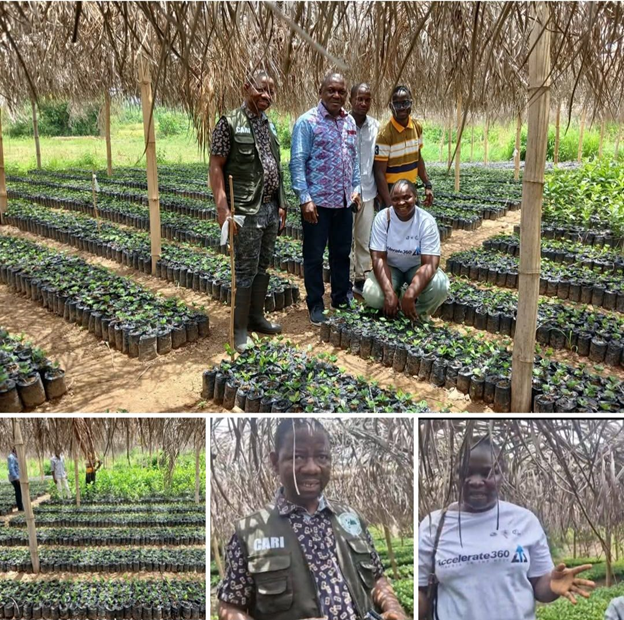
Liberia is taking decisive steps to reclaim its historic place on the global coffee map, with the government announcing plans to produce more than one million Liberica coffee seedlings through the Central Agricultural Research Institute (CARI). Officials say the initiative will revive the nation’s indigenous coffee heritage, create jobs, and strengthen rural livelihoods.
Assistant Minister for Development Planning at the Ministry of Finance and Development Planning, J. Wellington Barchue, led a Monitoring and Evaluation team this week to inspect CARI’s seed garden and the Seeds for Liberica Coffee Nursery Farm, where more than 400,000 seedlings are already under cultivation. The visit formed part of President Joseph Nyuma Boakai’s ARREST Agenda, which prioritizes agriculture, roads, rule of law, education, sanitation, and tourism.
Minister Barchue described Liberica coffee—first discovered in Liberia—as one of the country’s most valuable agricultural assets. Resistant to disease and climate stress, Liberica is prized for its large beans and strong aroma. Globally, it accounts for less than 2% of coffee production, making it a rare commodity with significant potential in specialty markets across Europe, North America, and Asia.
“Liberica coffee is Liberia’s traditional coffee. It was first discovered here and has enormous potential for economic transformation,” Barchue said.
CARI distributed more than 300,000 seedlings in 2025 across five counties and 25 farming communities. This year, authorities aim to distribute 475,000 seedlings, with long-term plans to reach 1.1 million by the end of next year. Officials say the expansion will help farmers restore abandoned plantations and rebuild Liberia’s coffee industry, which collapsed during the civil conflict between 1989 and 2003.
Dr. James S. Dolo, Head of the Crops Program at CARI, emphasized that the institute is spearheading coffee rehabilitation through its tree crops division. “We are recovering Liberica coffee so Liberia can regain control of its coffee heritage,” he said.
CARI is also producing improved seedlings for cocoa, oil palm, avocado, guava, soursop, and other crops. Dr. Dolo stressed that seedling production is demand-driven, ensuring farmers receive exactly what they request. “We do not want seedlings to waste in the nursery,” he explained.
Despite progress, researchers highlighted severe funding and mobility challenges. Some scientists are reportedly using personal funds to conduct field experiments, while limited transportation hampers monitoring and extension services in remote areas. “We need to follow up with farmers and detect crop diseases, but without mobility support, it is difficult,” said Ms. Dennis Kaway, Head of CARI’s Tree Crops Unit.
CARI manages approximately 1,650 acres of land for research and nursery development. Officials argue that with adequate support, the institute could transform Liberia’s agricultural sector. Minister Barchue pledged continued government oversight, assuring that field monitoring and direct engagement will remain central to policy implementation.
Once overshadowed by war and neglect, Liberia’s indigenous Liberica coffee is now emerging as a symbol of national recovery and economic opportunity. With expanding seedling production, international backing, and stronger government oversight, experts believe Liberia can reclaim its place in the global coffee industry while empowering thousands of rural farmers.
Would you like me to also prepare alternative headline options—for print, online, and radio layouts—so you can choose the most impactful one for each platform?

