


On paper, Numbase, LLC presents itself as an international technology firm with the pedigree and global footprint needed to take over one of Liberia’s most sensitive pieces of critical infrastructure: the national telecommunications monitoring system. Its website advertises a headquarters in Washington, D.C., an office in London’s upscale Knightsbridge district, and a presence in Monrovia — alongside claimed offices in Cyprus, the UAE, Qatar, Malaysia, and Tunisia.
In reality, a closer look at each of those claims raises more questions than it answers — and none of them comfortably.
As the Liberia Telecommunications Authority (LTA), under Commissioner Clarence Massaquoi, advances a push to replace Telecom International Alliance (TIA) as the country’s revenue-assurance and traffic-monitoring partner, the identity and technical capability of its preferred successor is coming under increasing scrutiny. What emerges from even a preliminary review is a company whose public-facing presence appears, on the available evidence, more illusion than enterprise.
A Washington “headquarters” that isn’t
Numbase’s own website lists its U.S. address as 1906 Sunderland Place NW, Washington, DC 23006, USA. The name evokes a K Street corridor of law firms, lobbyists and consultancies.
| FIGURE 1 │ NUMBASE.COM — “US” ADDRESS |
| Screenshot from numbase.com. The address given for the company’s U.S. office is “1906 Sunderland Place NW, Washington, DC 23006, USA.” Washington, D.C. ZIP codes are in the 200xx, 204xx and 205xx ranges; 23006 is not a valid Washington, D.C. ZIP code — it is a Virginia ZIP — which is an unusual error for a company that claims the U.S. capital as its base of operations. |
The reality on the ground is considerably more modest than the website implies. The property at 1906 Sunderland Place is not a corporate office tower. It is a very modest, run-down townhouse on a narrow side street just off Dupont Circle — a building that would be embarrassing for any serious company to call its Washington, D.C. headquarters. It looks almost residential rather than commercial, and nothing about its appearance, scale, or street presence is consistent with the kind of operation a national telecom-monitoring contractor would run out of the U.S. capital.
| FIGURE 2 │ 1906 SUNDERLAND PL NW — THE BUILDING |
| 1906 Sunderland Place NW, Washington, D.C. — the building Numbase lists as its U.S. office. A run-down townhouse with an external fire escape, on a near-residential side street. Nothing about the structure or its setting resembles a corporate headquarters. |
| FIGURE 3 │ GOOGLE STREET VIEW — SUNDERLAND PLACE NW |
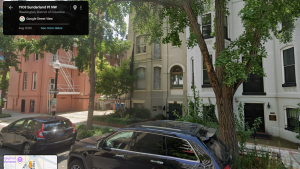 |
| Google Street View of Sunderland Place NW — a row of run-down townhouses. |
| FIGURE 4 │ ENTRANCE PLAQUE, 1906 SUNDERLAND PL NW |
| The only public indication of Numbase at the Washington address: a small shared-tenant plaque by the front door listing four LLCs — LAB-C, Numbase LLC, Digitalize Hub LLC and Play Holding LLC. Sharing a plaque with three other LLCs at a residential-scale rowhouse |
| FIGURE 5 │ 1906 SUNDERLAND PL NW — ENTRANCE |
| The entrance at 1906 Sunderland Place NW. |
When the building was canvassed, it showed no signage, directory listing, receptionist or other indication that Numbase operates there beyond its name on the shared plaque. Other tenants in the building said they had never seen anyone identifying themselves as being from Numbase, nor received mail or deliveries for the company. No employees could be located on the premises.
More striking still is what a search of the District of Columbia’s own corporate registry returns.
| FIGURE 6 │ D.C. DEPARTMENT OF LICENSING & CONSUMER PROTECTION — ENTITY SEARCH |
| Official District of Columbia entity-search portal (corponline.dlcp.dc.gov). A search for “Numbase” using the Contains option — the broadest available match — returns “No search result found.” Any company legally doing business in D.C. must be registered with the Department of Licensing and Consumer Protection. A company that actually maintained an operating office in Washington would appear here. Numbase does not appear to. |
The absence of any filing in the D.C. corporate registry is, at minimum, inconsistent with Numbase’s own public representation that Washington is one of its principal offices. It raises a basic question: if Numbase is genuinely operating out of the U.S. capital, why does it appear nowhere in the jurisdiction’s corporate registry? And if it is not operating there, on what basis is it advertising a Washington headquarters to governments evaluating it for a major public contract?
“If Numbase is genuinely operating out of the U.S. capital, why does it appear nowhere in D.C.’s corporate registry?”
A Knightsbridge address that belongs to someone else entirely
Numbase’s website lists a London office at 64 Knightsbridge, London SW1X 7JF — an address that lends any company an unmistakable air of establishment prestige, located across from Hyde Park in one of the most expensive postcodes in Europe.
| FIGURE 7 │ NUMBASE.COM — “UK” ADDRESS |
| Numbase’s website listing its UK office as “64 Knightsbridge, London SW1X 7JF, United Kingdom.” |
The address is real. The tenant is not Numbase.
| FIGURE 8 │ 64 KNIGHTSBRIDGE — GOOGLE MAPS |
 |
| Google Maps listing for 64 Knightsbridge, London SW1X 7JF. The registered occupant is the Pavilion Club, a private members’ club (category: “Club”) with a 4.5-star rating based on 77 reviews, reachable at +44 20 7484 5755 and via pavilion.club. |
64 Knightsbridge is the home of the Pavilion Club — a private members’ club. Its marketing prominently features fine-dining restaurants, cocktail bars, a rooftop terrace overlooking Hyde Park, and glossy promotional imagery trading heavily on glamour, including photographs of young women in evening wear. It is, in short, a venue for dinner, drinks and nightlife, not a technology company’s operations centre.
| FIGURE 9 │ PAVILION.CLUB — THE “OFFICE” NUMBASE CLAIMS IN LONDON |
The obvious question follows: is it serious to call a members’ nightlife club a place of business? Does Numbase conduct telecom-monitoring work between the cocktail lounge and the Michelin-starred dining room? There is no independent evidence that Numbase maintains a dedicated office, staff, or technical infrastructure at 64 Knightsbridge — only the address printed on its website. For a company bidding to monitor an entire country’s telecommunications traffic, citing a members’ club as one’s London base is, at best, extraordinary.
A Monrovia office with no address
If the Washington and London presences are thinly evidenced, the Liberian one is effectively invisible.
| FIGURE 10 │ NUMBASE.COM — “LIBERIA” LISTING |
| Numbase’s website entry for Liberia under “Global Presence.” When expanded, it reads simply “Monrovia” — with no street address, no suburb, no building, no floor, and no phone line. Every other listed office on the site shows a street-level address; Liberia alone is reduced to a city name. |
Numbase’s website claims a Monrovia office — a claim that would be highly relevant given the nature of the work it proposes to perform and the Liberian government’s stated interest in domestic capability. Yet no physical address is listed for the Monrovia office. No street. No suburb. No building name. No phone line dedicated to the Liberian operation.
This is an unusual omission for a company presenting itself as locally established in the very country where it is seeking a major government contract. It is also an omission that cannot be reconciled with the company’s display of a street-level address for its U.S. and UK presences — even though those street-level addresses, as shown above, do not correspond to functioning offices either.
Earlier reporting by Liberian outlets — including FrontPage Africa, The New Dawn and the Liberian Observer — has raised similar concerns about the joint-venture structure said to be behind the proposed arrangement, “Numtel Liberia JV Numbase LLC,” noting that the agreement was reportedly signed on behalf of the joint venture by one James Sackie — an individual about whom virtually no public information exists.
The technical question no one has answered
Telecommunications monitoring — of the kind TIA performed under its concession with the LTA — is not an administrative service. It is a highly specialised technical undertaking. Under the suspended TIA agreement, the contractor was responsible for monitoring national and international voice, data, and mobile-money traffic; conducting revenue assurance to verify operators’ reported figures; and detecting and preventing telecom fraud, including unreported traffic. The system was designed as an independent verification mechanism to prevent underreporting of telecom revenues, which are among Liberia’s most significant non-tax income streams.
To perform that role credibly, a monitoring provider needs, at minimum: deployed probes and monitoring equipment at interconnect points and international gateways; secure data centres or carrier-grade hosting; staffed 24/7 network-operations capability; a demonstrated track record with other regulators or operators; engineers with fraud-management, SS7, VoIP and mobile-money analytics expertise; and defensible data-protection and national-security safeguards.
Numbase’s public footprint evidences none of these. The company has no identifiable engineering team, no published case studies, no list of prior regulator or carrier clients, no technical white papers, no conference appearances, and no publicly visible certifications. A company with genuine monitoring capability leaves a trail in industry databases and trade press. Numbase does not appear to.
The absence of such evidence does not, by itself, prove incapability. But the burden of proof in a matter of this significance sits unambiguously with the vendor — and, crucially, with the regulator contracting it.
The Massaquoi question
Which brings the inquiry back to Liberia, and to Commissioner Clarence Massaquoi.
Multiple Liberian news outlets have reported that the push toward Numtel Liberia JV Numbase LLC as TIA’s replacement is being driven particularly insistently by the LTA’s leadership. The suspension of TIA’s concession was effected in October 2025 through Executive Order No. 154, citing audit findings by the General Auditing Commission and the Liberia Anti-Corruption Commission. That Executive Order directed the LTA to coordinate with the Public Procurement and Concessions Commission (PPCC) to engage a qualified service provider without delay.
“Qualified” is the operative word. A legislative committee that reviewed the TIA matter had recommended renegotiation of the existing concession rather than outright replacement, and a number of lawmakers are reported to have urged the same course. Historically, Liberia has preferred renegotiation over cancellation for major concession disputes — ArcelorMittal, Firestone, CTN, MedTech and LTMI have all been renegotiated rather than torn up.
The questions now being asked in Monrovia, and deserving of direct answer, are straightforward:
01 What due-diligence process did the LTA conduct on Numbase, LLC and its Liberian JV partner before advancing them as TIA’s replacement? Specifically, was the company’s corporate registration status in Washington, D.C. verified? Was a site visit conducted at any of its three claimed offices? Was its technical capability independently assessed?
02 Who conducted that due diligence, and is the resulting report available for legislative review?
03 Why was this particular company identified, and by whom was it introduced to the LTA?
04 Why has Commissioner Massaquoi been so insistent on this specific vendor, rather than running an open, competitive procurement through the PPCC in line with the Executive Order’s own language?
05 Who are the ultimate beneficial owners of Numbase, LLC and of the Liberian joint-venture partner? Liberia’s own anti-corruption and procurement frameworks require beneficial-ownership transparency for contracts of this size and sensitivity.
Neither the LTA nor Commissioner Massaquoi has publicly addressed the discrepancies between Numbase’s stated presence and its actual footprint. The company itself did not respond to requests for comment through the contact channels listed on its website.
What’s at stake
Telecom monitoring is not a ceremonial function. It is the mechanism by which a government verifies how much revenue its licensed operators actually generate — and, by extension, how much tax and regulatory revenue the state is owed.
It is also a matter of national security: the contractor has visibility into traffic patterns, call-detail records and, depending on the architecture, the ability to detect or miss fraudulent bypass of the national network.
Handing that function to a company whose Washington headquarters appears to be a run-down, near-residential townhouse advertised with an incorrect ZIP code, whose London office is in fact a members’ nightlife club, whose Monrovia office has no address, and which does not appear in the corporate registry of the jurisdiction it claims as its base — without a transparent, documented due-diligence process — would be an extraordinary decision.
Liberia has been here before, with concessions awarded on thin grounds and litigated for years afterward at considerable cost to the public purse. The suspension of TIA was justified by the Executive on the basis of audit and integrity concerns. Whatever the merits of that decision, replacing TIA with an entity whose own integrity cannot be established from its public record would invert the stated rationale entirely.
The LTA owes the Liberian public — and the legislature that ratified the TIA concession in the first place — clear, documented answers before any contract with Numbase, LLC is signed, extended, or operationalised.
Until then, the most honest description of Numbase, on the available evidence, is not “Liberia’s next telecom monitor.” It is a company with three addresses and questionable visible operations.

