

Liberia has taken a decisive step in the fight against illegal logging and cross-border timber trafficking. The United States Forest Service (USFS), in collaboration with the Forestry Development Authority (FDA) and the Liberia Revenue Authority (LRA), concluded a four-day joint law enforcement training in Buchanan City, aimed at strengthening Liberia’s capacity to detect, disrupt, and prosecute timber-related crimes.
The initiative, funded by the U.S. State Department’s Bureau of International Narcotics and Law Enforcement Affairs (INL), forms part of a broader regional program spanning Ghana and Senegal. It underscores Washington’s long-standing commitment to supporting Liberia’s civilian, security, and justice institutions.
The training opened with senior FDA officials, customs officers, and representatives from the U.S. Embassy. Madam Gertrude W.K. Nyale, FDA’s Deputy Managing Director for Commercial and Technical Services, expressed gratitude to the U.S. government for its continued support in building Liberia’s forestry governance frameworks.
She emphasized that reforms since 2003 have helped safeguard natural resources and boost national revenue. Nyale urged customs officers to apply the lessons at border posts and ports of entry to ensure a transparent and legal timber trade.
Mr. Stephen Kissik, Senior Police Advisor at the U.S. Embassy, praised the strong turnout and described the program as part of America’s enduring commitment to Liberia’s institutional resilience. He stressed that equipping frontline officers with modern tools and interagency networks is critical to preventing environmental and economic harm caused by timber trafficking.
A highlight of the training was the introduction of Xylorix Enforcer, an AI-based wood identification application designed to enhance timber verification at checkpoints. Dr. Benedictus Freeman and Mr. Sayon Fofana of USFS Liberia showcased the tool, which allows officers to quickly identify timber species and detect illegal consignments.
FDA’s Technical Manager of Commercial Forestry, Mr. Albert Blanyon, led sessions on timber law enforcement and operational procedures. Other experts covered a wide range of topics:
On the third day, FDA Managing Director Rudolph J. Merab, Sr. visited the training site. He commended USFS for organizing the program and urged participants to take the training seriously. Merab reiterated the urgent need to protect Liberia’s borders and entry points from timber trafficking, warning that illegal logging undermines both environmental sustainability and national revenue. He expressed deep appreciation to the U.S. government for its unwavering support of Liberia’s forestry sector.
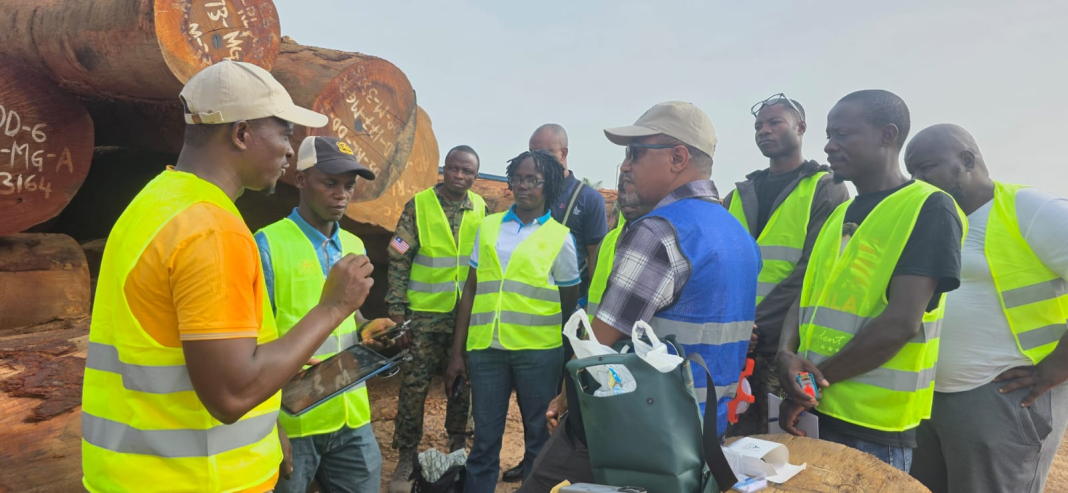
The training concluded with a practical exercise at the Krish Veneer Industries log yard in Grand Bassa County. Participants engaged in hands-on demonstrations, applying newly acquired skills in log verification, scaling, and volume calculation. The exercise reinforced the importance of operational accuracy and interagency collaboration in combating timber-related crimes.
Illegal logging remains one of the gravest threats to Liberia’s forests, undermining biodiversity, fueling corruption, and depriving the state of vital revenue. By equipping FDA and LRA officers with advanced tools, technical knowledge, and interagency networks, the U.S.-backed training represents a significant stride toward stronger governance and sustainable forest management.
As Liberia positions itself as a regional leader in forestry oversight, the Buchanan training sends a clear message: illegal timber trafficking will no longer be tolerated. With international support and local commitment, the country is charting a path toward transparency, accountability, and environmental protection.

