

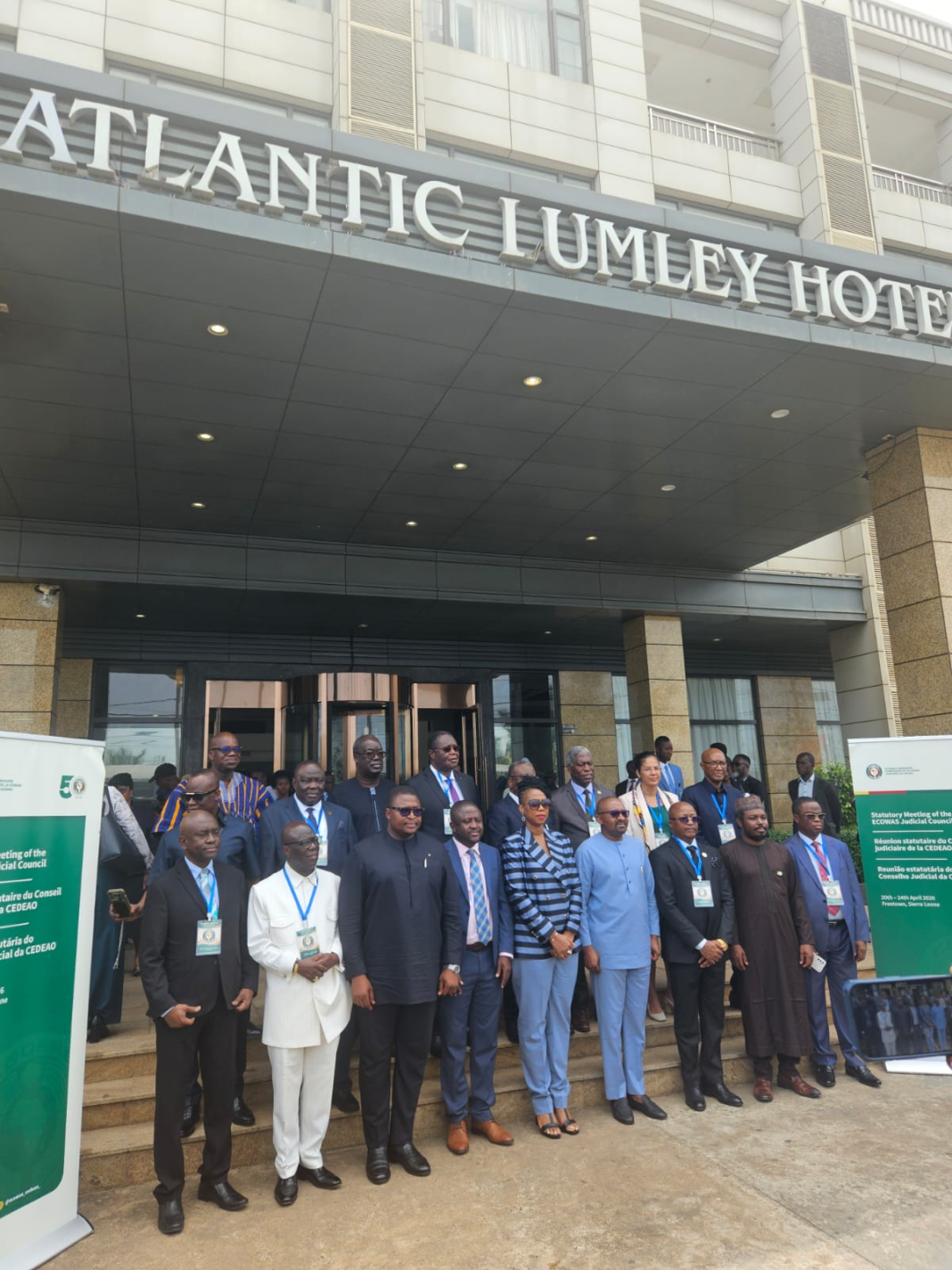
In Freetown this week, Liberia’s Chief Justice Yamie Quiqui Gbeisay Sr. joined fellow ECOWAS Chief Justices in a high-level courtesy call on Sierra Leone’s President Julius Maada Bio, Chairman of the Authority of ECOWAS Heads of State. Their collective message was clear: the ECOWAS Court must be empowered to enforce its judgments if justice is to have meaning across the region.
Chief Justice Gbeisay, attending the ECOWAS Statutory Meeting from April 20–24, underscored the court’s achievements in advancing human rights since its creation.
He described the ECOWAS Community Court of Justice as a “brainchild of ECOWAS” that has played a pivotal role in protecting citizens against abuses of power. Yet, he cautioned, its credibility is undermined by a persistent weakness—the inability to enforce its rulings.
“The essence of a court is to render judgment, and the essence of judgment is enforcement,” Gbeisay declared. “When judgment is enforced, justice is served. Without enforcement, the court becomes a waste of time, resources, and energy.”
His remarks carried weight as he appealed directly to President Bio, urging him to leverage his authority as ECOWAS Chair to champion reforms. Gbeisay emphasized that enforcement mechanisms must be strengthened to ensure that the court’s decisions are not symbolic pronouncements but binding instruments of justice. He described Bio as a charismatic leader capable of mobilizing political will to close this gap.
The call reflects growing frustration among legal practitioners and civil society groups who argue that the ECOWAS Court, despite its promise, risks irrelevance if member states continue to ignore its judgments. For many, the court represents a beacon of regional accountability, offering citizens recourse when national systems fail. But without enforcement, its rulings remain paper victories.
The meeting in Freetown thus became more than a ceremonial exchange—it was a plea for action. As ECOWAS grapples with challenges of governance, democracy, and human rights, the effectiveness of its judicial arm will determine whether the regional bloc can deliver justice beyond rhetoric.
Chief Justice Gbeisay’s intervention highlights a pressing truth: a court without enforcement is powerless. His appeal to President Bio may well mark the beginning of a renewed push to give the ECOWAS Court the authority it needs to serve the people of West Africa.

