

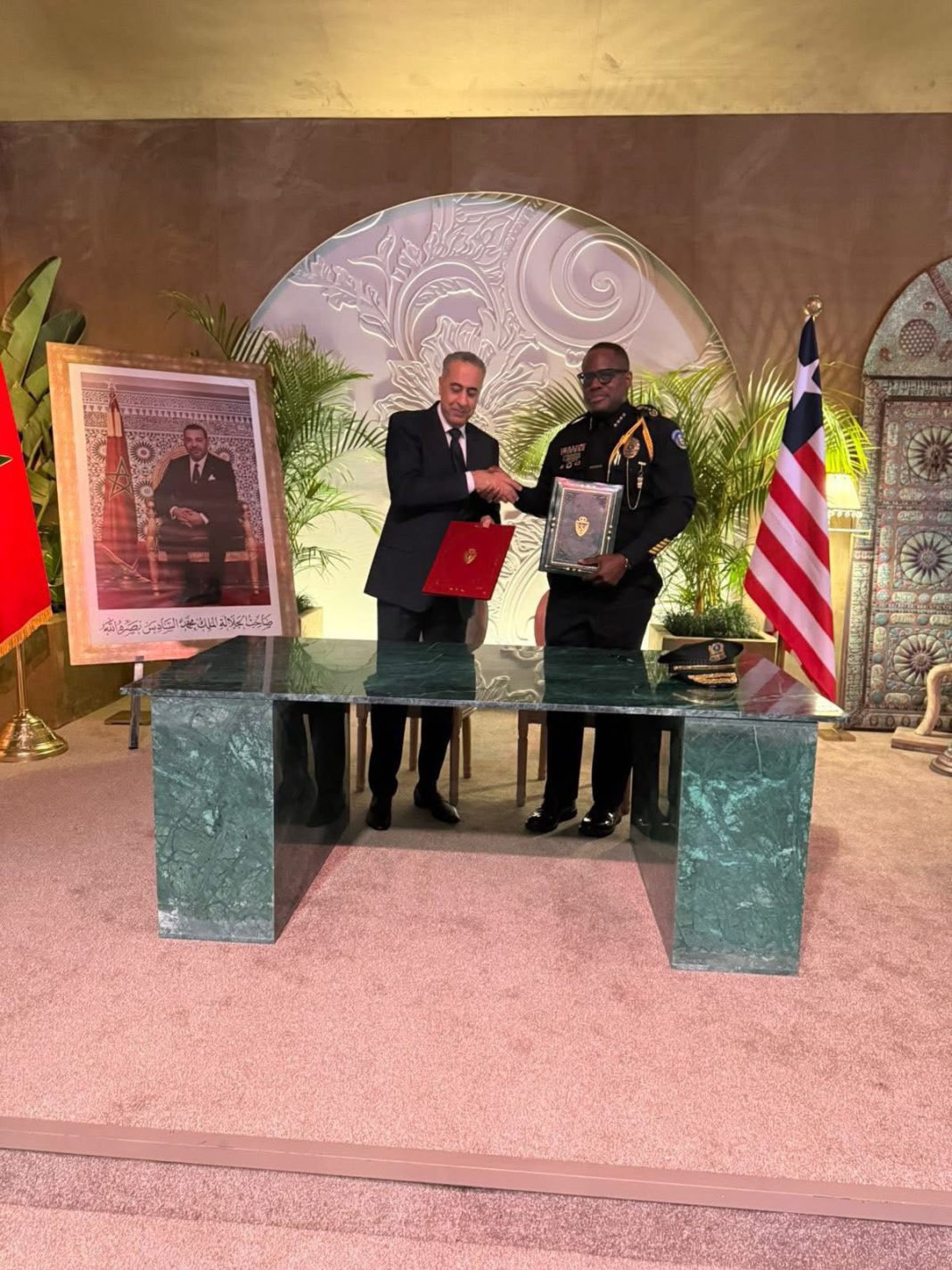
In a dramatic leap forward for Liberia’s security modernization drive, the Liberia National Police and Morocco’s General Directorate of National Security have inked a landmark Memorandum of Understanding (MoU) that officials hail as a game‑changing alliance in global policing and intelligence cooperation.
The pact, signed today in Monrovia, establishes a sweeping framework for collaboration across critical areas: intelligence sharing, counterterrorism, cybersecurity, forensic science, specialized police training, organized crime prevention, and border security.
Authorities say the agreement will sharpen Liberia’s institutional coordination and equip its officers with cutting‑edge expertise to confront increasingly complex transnational threats — from cybercrime and human trafficking to violent extremism and organized criminal networks.
The deal comes as West Africa and the Sahel grapple with instability, illicit trafficking, and extremist violence, forcing governments to intensify intelligence and border security cooperation. Morocco, already recognized as a continental hub for counterterrorism diplomacy, has expanded its partnerships across Africa, Europe, and Asia, offering advanced police modernization programs and intelligence frameworks.
For Liberia, the MoU represents another milestone in rebuilding institutions scarred by years of civil conflict. The Liberia National Police, founded in 1956 and restructured during the UNMIL‑backed post‑war transition, currently employs about 4,100 officers. Despite persistent challenges in logistics, staffing, and technology, the force is pushing forward with reforms aimed at professionalizing policing and strengthening public safety.
By contrast, Morocco’s national security system — also established in 1956 — boasts nearly 80,000 personnel and a formidable record in counterterrorism, forensic investigations, and intelligence coordination. Analysts say Liberia’s partnership with such a seasoned institution could dramatically elevate its investigative capacity and accelerate technology‑driven policing reforms.
The signing also underscores deepening ties between Monrovia and Rabat under the broader South–South cooperation framework, which promotes collaboration among developing nations in governance, infrastructure, education, and security. Earlier engagements between Liberian and Moroccan security leaders laid the groundwork for today’s pact, focusing on operational coordination and specialized training exchanges.
Liberian authorities expressed gratitude to President Joseph Nyuma Boakai Sr., the Government of Liberia, and international partners for backing what they described as a transformative step toward institutional modernization and strengthened public safety nationwide.
Officials emphasize that the agreement signals Liberia’s determination to align domestic security systems with emerging global standards — a bold stride into a new era of international law enforcement cooperation.

