

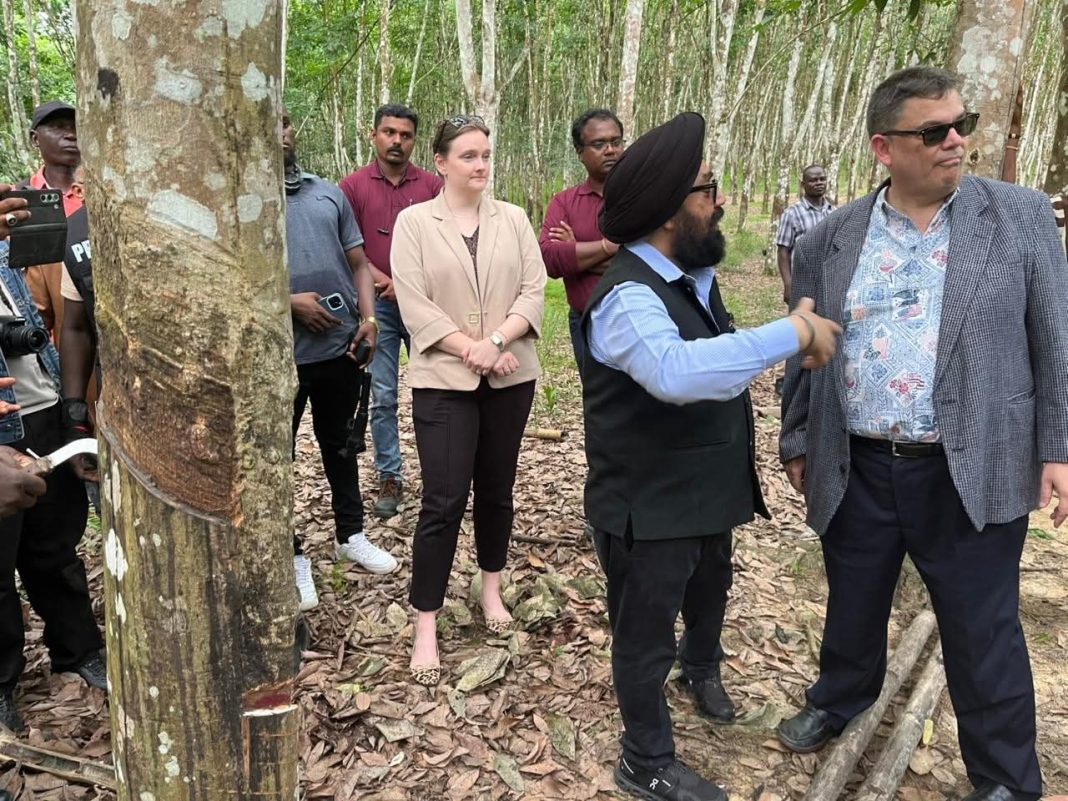
Jeety Rubber’s processing plant in Margibi County is emerging as a direct link in the U.S. tire supply chain, America’s top diplomat in Liberia said after a May 19 visit that underscores growing commercial ties between the two countries.
Charge d’Affaires Joseph Zadrozny visited Jeety Rubber to observe operations and highlighted that the firm’s processed rubber ships directly to the Port of Savannah to supply U.S. tire manufacturers.
In a statement on the U.S. Embassy in Monrovia’s Facebook page, Zadrozny considered Jeety’s exports as a “tangible example of bilateral trade” that aligns with Washington’s push for “fair, transparent, and resilient supply chains.”
He also praised the company’s investments in healthcare, education, water access and local employment — initiatives the embassy said reflect U.S. priorities for responsible private‑sector growth.
Jeety Rubber, owned by Upjit Singh Sachdeva, is completing a roughly $18 million second‑phase expansion that will nearly double processing capacity by adding a new line capable of eight tonnes per hour to the existing five‑tonne line. The upgrade is about 60% complete and is expected to begin operations in June or July 2026.
The plant currently processes about 200–250 tonnes of wet rubber per day. Management says roughly 550 tonnes per day of wet rubber would be required to sustain domestic tire manufacturing and meet the company’s target of producing Liberia’s first domestically made tire by mid‑2028.
Jeety has completed feasibility studies for truck, passenger, motorcycle and tricycle tires but warns that further downstream investment — potentially $35–40 million — depends on securing consistent raw‑material flows.
The company has urged the Liberian government to restrict exports of unprocessed rubber (“cuplumps”), arguing that exporting raw material shifts value‑added work offshore and robs Liberia of manufacturing jobs.
Jeety has also called for policy changes to strengthen farm‑gate pricing as an incentive for higher production and improved rural incomes.
To secure feedstock, Jeety acquired Salala Rubber Corporation (SRC) in 2024, preserving some 900 jobs and integrating plantation supply into its processing chain.
Direct shipments to the Port of Savannah position Jeety as a supplier to U.S. tire makers at a time when American policy priorities emphasize diversifying and de‑risking sourcing of critical commodities.

