

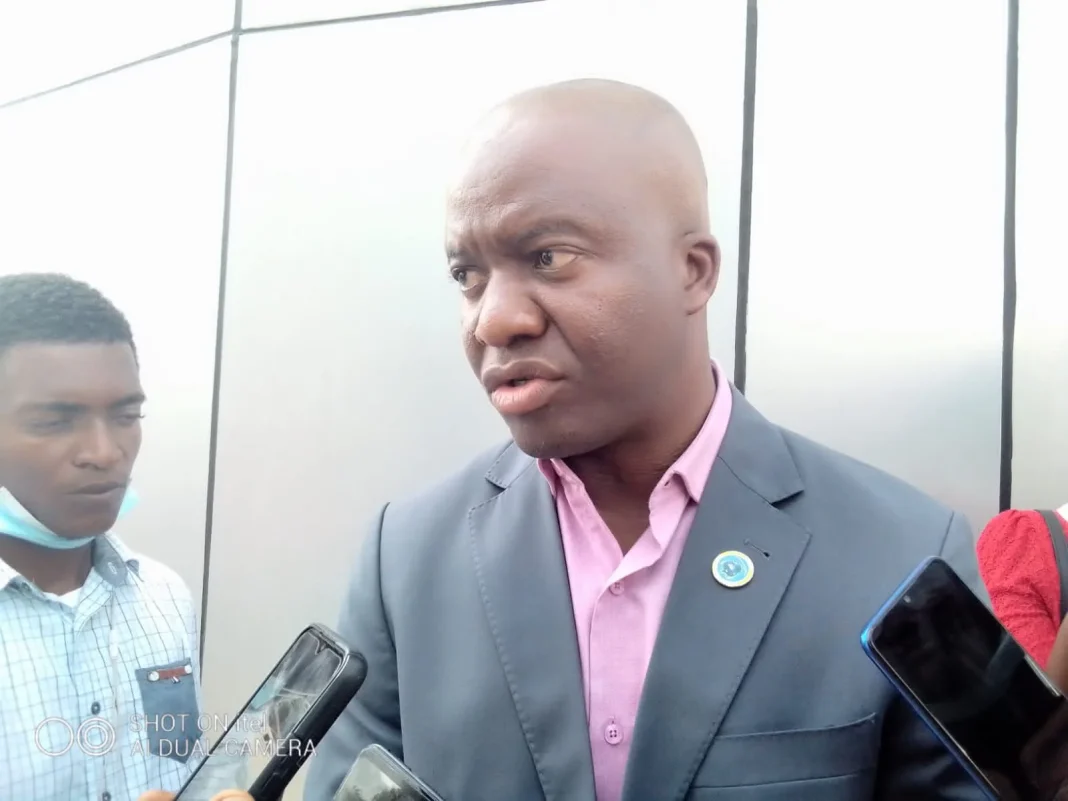
Liberia Telecommunications Authority (LTA) Chairman Clarence Massaquoi has declined to disclose the amount of revenue generated from the country’s telecommunications traffic monitoring system since assuming office, insisting that he is accountable only to President Joseph N. Boakai.
The vital sector revenue inflow could be in millions of United States dollars.
Speaking during the Ministry of Information’s regular press briefing on Friday, Massaquoi rejected repeated calls from journalists and civil society organizations for the LTA to publicly account for revenues collected through telecommunications traffic monitoring.
According to its website, it an independent commission of government established by the Telecommunications Act 2007 and clothed with the authority to regulate the telecommunications sector of Liberia. Some of its responsibilities include: Advise government on policy for the telecommunications sector Develop and enforce Regulations, Decisions, Rules and Orders for the telecommunications sector.
Its core values rest on fairness, credibility, transparency and acceptability. But the Commissioner has decided to avoid transparency in disclosing its revenue to the public.
“If they want me to say where the money is, I will not say it. I will report to the President,” Massaquoi stated. “I can only assure the public that this Board of Commissioners—I can vouch for the character of each of my colleagues. All funds generated, today as I stand on this podium, if I were to receive a call from the Chief Executive to press the button to transfer, I will do it right from this point.”
His remarks have reignited debate over transparency, public accountability, and oversight of one of Liberia’s most significant telecommunications revenue streams.
The controversy follows a formal complaint submitted by journalist Alfred Togba to both the Liberia Anti-Corruption Commission (LACC) and the General Auditing Commission (GAC), requesting investigations into the financial management and operations of the LTA.
Although Massaquoi dismissed the allegations as unfounded, he stated that the Authority would cooperate with any lawful investigation. The LACC has confirmed receiving the complaint and indicated that similar concerns regarding the Authority had already been brought to its attention.
The LTA has yet to publish comprehensive figures showing how much revenue has been generated from telecommunications traffic monitoring since the suspension of the previous monitoring arrangement.
Liberia’s telecommunications traffic monitoring program was introduced to strengthen regulatory oversight, improve revenue assurance, combat international call bypass fraud, and ensure accurate payment of regulatory fees by licensed telecommunications operators.
In 2018, the Government of Liberia entered into an agreement with Telecom International Alliance (TIA), an American company, to provide comprehensive telecommunications traffic monitoring and revenue assurance services. The agreement was subsequently amended and, in 2022, transformed into a concession agreement that was ratified by the National Legislature.
The concession authorized TIA to deploy modern traffic monitoring technology capable of independently capturing and analyzing telecommunications traffic from licensed operators. The objective was to provide the LTA with accurate data for regulatory enforcement, revenue verification, and fraud detection while improving transparency within the sector.
In 2024, following questions surrounding the concession, the Ministry of Justice issued a legal opinion concluding that the agreement remained legal, valid, and enforceable unless declared otherwise by a court of competent jurisdiction.
Following President Joseph Boakai’s suspension of the TIA concession pending investigation, both Houses of the National Legislature conducted extensive reviews of the agreement.
Rather than recommending cancellation, the Joint Committee concluded that renegotiation would better protect Liberia’s legal obligations while preserving investor confidence.
Among those supporting renegotiation were Senators Albert Chie, Amara Konneh, and Darius Dillon, together with Representatives Foday Fahnbulleh, Ivar K. Jones, Judith Wiah, and Marie Johnson.
The committee recommended that Government:
Lift the suspension of the concession;
Suspend negotiations for any competing monitoring arrangements;
Engage TIA in renegotiation consistent with Liberian law; and
Preserve Liberia’s reputation as a country that respects legally executed investment agreements.
The committee observed that Liberia has historically resolved disputes involving major concessionaires—including ArcelorMittal Liberia and Firestone—through negotiation rather than unilateral cancellation.
Continuing Questions Over Monitoring Capacity
Since the suspension of TIA, questions have persisted regarding the LTA’s current technical capacity to independently monitor telecommunications traffic.
Telecommunications experts note that modern regulatory traffic monitoring requires secure, real-time connections with operators’ switching systems, sophisticated software capable of processing signaling data and call detail records, continuous software updates, and specialized analytical platforms.
Industry observers have argued that effective monitoring cannot be achieved solely through physical equipment without the corresponding licensed software, network integration, and ongoing technical support required to analyze modern telecommunications traffic.
These questions have fueled calls for greater transparency regarding the current monitoring system, revenue generated since the suspension of the previous arrangement, and the methodologies used to verify telecommunications traffic and regulatory fees.
Previous Public Debate
Massaquoi’s recent comments add to a series of public discussions surrounding the LTA’s management of the telecommunications sector.
Over the past year, media reports have highlighted debates over the implementation of telecommunications monitoring, the status of the suspended TIA concession, regulatory revenue collection, and the Authority’s contractual arrangements for monitoring services.
These issues have remained at the center of public discourse because telecommunications traffic monitoring represents an important mechanism for ensuring government revenue, combating fraud, and maintaining confidence in Liberia’s telecommunications regulatory framework.
Governance advocates argue that while the LTA reports administratively through the Executive Branch, the Authority remains a public institution entrusted with managing public resources.
As such, they contend that periodic disclosure of revenues generated, audited financial statements, and operational performance reports are essential components of good governance and public accountability.
With investigations reportedly underway at the LACC and GAC, observers say the outcome of those inquiries—together with the Government’s eventual decision on the future of telecommunications traffic monitoring—will have significant implications for regulatory transparency, investor confidence, and public trust in Liberia’s telecommunications sector.

