

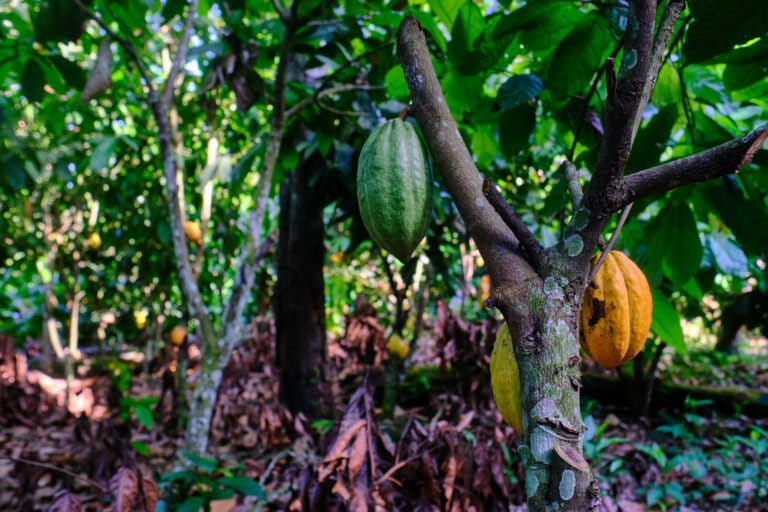
On this week’s episode of the Mongabay Newscast, we speak with features writer Ashoka Mukpo, who traveled to southeastern Liberia to investigate what satellite images indicated was a spike in deforestation over a relatively concentrated period. Along with video production coordinator Juan Maza, Mukpo documented illegal cacao plantations in the rainforests in the county of Grand Gedeh. In this interview, he explains how and why these plantations are appearing now in Liberia.
“What we saw … probably the best metaphor for it is that there’s a kind of gold rush happening in this part of Liberia, except it’s not gold that people are after, it’s cocoa,” Mukpo says.
“And this makes sense, given the context that in the last few years there was a huge price spike for cocoa, and this had to do with a lot of factors, including climate change and a poor harvest in Côte d’Ivoire. And so that’s pushing this huge number of migrant workers from Côte d’Ivoire into Grand Gedeh.”
At the end of the year, the European Union Deforestation Regulation (EUDR) is set to take effect. The EU legislation would ban the importation of certain commodities produced via deforestation, and one of those commodities is cocoa. And much of the cocoa being grown in Liberia right now would potentially fall under this ban, Mukpo says. Furthermore, setting up the tracking infrastructure to ensure commodities meet EUDR standards is expensive. While nations like Côte d’Ivoire have already invested in this, Liberia has not. That leaves a lot of farmers who are betting on this commodity vulnerable.
“A lot of farmers are gonna suffer just from lack of clarity. And I could see a scenario where suppliers choose to just not buy from Liberia because if there’s no way for them to know where these beans are coming from, they could get in a lot of trouble if they do buy, and I think that’s the real concern,” Mukpo says.
The deforestation happening in Liberia due to cocoa challenges the narrative of a clear villain, he says; it’s more the result of a system where farmers struggling to make a living feel they have no choice, while the European Union is trying to make good on a promise that its own demand for tropical forest commodities doesn’t contribute to deforestation.
“I think this is much more just a reflection of a system and a reflection of a mind state,” Mukpo says. “On one hand, these farmers in Gran Gedeh want better lives, and you have to sympathize with them for that. And then on the other hand, and this is what the policymakers in the EU that I spoke to had to say, is that they understand that frustration and that impulse, but they feel like their market has some responsibility to not participate in deforestation. And I find both of those perspectives compelling and understandable, and the problem is that they’re not really compatible.”
Cacao cultivation experts Mukpo spoke with say the method of farming used, which cuts down and/or burns patches of forest to make way to plant cacao saplings, isn’t necessary at all. Agroforestry, when provided with the upfront investment, could produce comparable yields without the deforestation.
“There are novel ways of cultivating cocoa as part of agroforestry schemes that the cocoa is incredibly productive, and you don’t have to destroy the forest to grow it,” Mukpo says. “But it takes a little bit more money, it takes a little bit more patience, it takes a little bit more investment.”
- Mike DiGirolamo/Mongabay

