

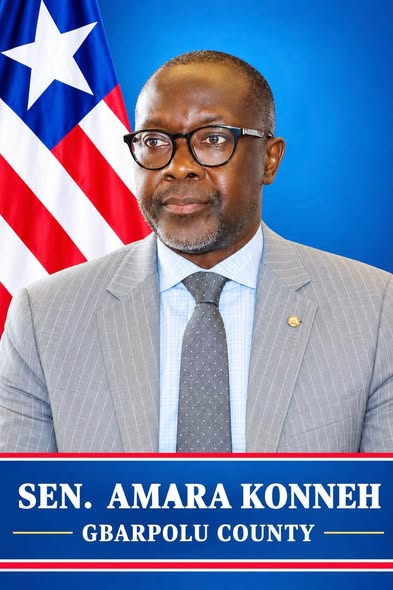
By E. J. Nathaniel Daygbor
Senator Amara M. Konneh of Gbarpolu County has raised concerns over key aspects of Liberia’s proposed US$1.539 billion Fiscal Year 2027 National Budget, questioning the credibility of projected revenues, the government’s spending priorities, and the limited allocation of development funds to counties and critical sectors such as agriculture.
In a detailed statement released following President Joseph Nyuma Boakai’s submission of the draft budget to the Legislature, Konneh welcomed the constitutional process of legislative review but stressed that lawmakers must rigorously examine whether the budget’s assumptions are realistic and whether public spending reflects the needs of ordinary Liberians.
The proposed budget represents an increase of approximately US$236 million, or 18.1 percent, over the estimated US$1.303 billion budget for FY2026. While acknowledging the significance of the expanded fiscal envelope, Konneh said the true measure of success lies not in the size of the budget but in its ability to improve living conditions, create jobs, and stimulate economic growth.
“The task now before the Legislature is to determine whether the revenue projections are credible, whether expenditure choices reflect national priorities, and whether the budget can be implemented as presented,” he said.
Central to Konneh’s concerns is the government’s assertion that it intends to broaden the tax base without increasing tax rates.
The senator argued that the figures contained in the draft budget tell a different story.
According to his analysis, tax revenue is projected to increase by US$225 million, rising to US$1.072 billion, while non-tax revenue is expected to decline sharply by US$164 million. As a result, net domestic revenue growth amounts to only about US$61 million, or 4.7 percent.
Konneh, a onetime finance minister, noted that much of the projected tax increase depends on a nearly 50 percent rise in import taxes, significant increases in taxes on goods and services, the introduction of Value Added Tax (VAT), mobile money-related charges, and penalties linked to electronic receipt compliance.
Rather than reflecting genuine economic expansion, he argued, the revenue projections appear to represent a restructuring of existing tax streams that may place greater pressure on businesses and households already carrying a substantial tax burden.
He called on lawmakers to demand a detailed breakdown of projected revenue gains to determine how much stems from economic growth, new tax measures, and improvements in tax administration and compliance.
“Broadening the tax base should mean bringing more economic activity into the formal tax net, not simply collecting more from the same taxpayers,” he said.
Konneh also questioned the composition of public expenditure, contending that the budget allocates too much toward government operations and too little toward development projects that directly benefit citizens.
Of the additional US$236 million proposed in the FY2027 budget, only about US$16.4 million, or roughly 7 percent, is earmarked for public sector investment projects. The bulk of the increase, he observed, is directed toward recurrent expenditures, including grants, compensation, goods and services, and debt obligations.
According to the senator, nearly 79 cents of every dollar in the proposed budget will be spent on operating government and servicing debt, leaving only 21 cents for development initiatives.
“This means more spending on administration and bureaucracy while critical sectors continue to face resource constraints,” he argued.
The senator acknowledged increased allocations to both the health and education sectors but questioned whether these increases would translate into improved services.
While the health budget is projected to rise from US$110.9 million to US$135.8 million, he noted that much of the increase appears concentrated within the Ministry of Health in Monrovia rather than frontline hospitals and clinics across the country.
Similarly, although education spending is expected to increase from US$143.6 million to US$163.5 million, funding for instructional materials and classroom supplies in the counties is projected to decline.
He welcomed planned salary increases for teachers and health workers but stressed that investments in learning materials, medicines, laboratory supplies, and community health services remain equally essential.
The senator warned that ordinary Liberians are already grappling with high living costs and could face additional pressure if revenue measures lead to higher prices for imported goods and basic commodities.
He cited persistent concerns about food, transportation, and fuel costs and urged lawmakers to carefully review any tax measures that may increase the burden on struggling households.
“Relief must be targeted and verifiable,” Konneh stated, emphasizing the need to ensure that social spending reaches communities outside Monrovia and supports essential services such as health care and education.
Konneh reserved some of his strongest criticism for what he described as inadequate support for agriculture and county-based development.
Despite employing a significant share of Liberia’s workforce, agriculture receives only about 1.2 percent of the proposed national budget, he noted. The senator pointed to slow sector growth and rising domestic food inflation as indicators that greater investment is urgently needed.
He urged lawmakers to examine whether allocations for seeds, agricultural research, extension services, feeder roads, storage facilities, and market access are sufficient to boost domestic food production and reduce dependence on imports.
The senator further proposed that policymakers explore a gradual increase in agriculture’s share of the national budget to 10 percent within two years, provided such an expansion is economically feasible and effectively managed.
Beyond agriculture, Konneh raised concerns about county development spending. Excluding road projects, the budget allocates only about US$11.2 million for development initiatives across Liberia’s 15 counties. By comparison, more than US$106 million is earmarked for road infrastructure.
While supporting investment in roads, he argued that counties also need clinics, schools, markets, water systems, and economic infrastructure capable of stimulating local development.
Using Gbarpolu County as an example, Konneh highlighted what he described as glaring disparities in resource allocation.
The draft budget identifies approximately US$2.55 million in direct funding for the county, including allocations for local government, health, and education. However, he noted that most of the health allocation is directed toward the Emirates Hospital, leaving limited resources for health centers serving communities across the county’s six districts.
He also observed that none of the budget’s 194 listed development projects specifically identifies Gbarpolu as a beneficiary with a clearly stated allocation.
Konneh called for greater transparency, including disclosure of project costs and budget codes, to enable lawmakers and citizens to monitor implementation and ensure accountability.
As legislative hearings commence, the senator emphasized that his observations are intended to strengthen, rather than undermine, the budgeting process.
“I want this budget to succeed,” he said. “But success cannot be measured by the size of the budget alone. It must be measured by better schools, functioning hospitals, productive farms, jobs for young people, and a fair share of national development for every county.”
The Legislature is expected to begin detailed scrutiny of the draft FY2027 National Budget in the coming weeks, with committees examining revenue projections, expenditure allocations, and implementation priorities before final approval.

