

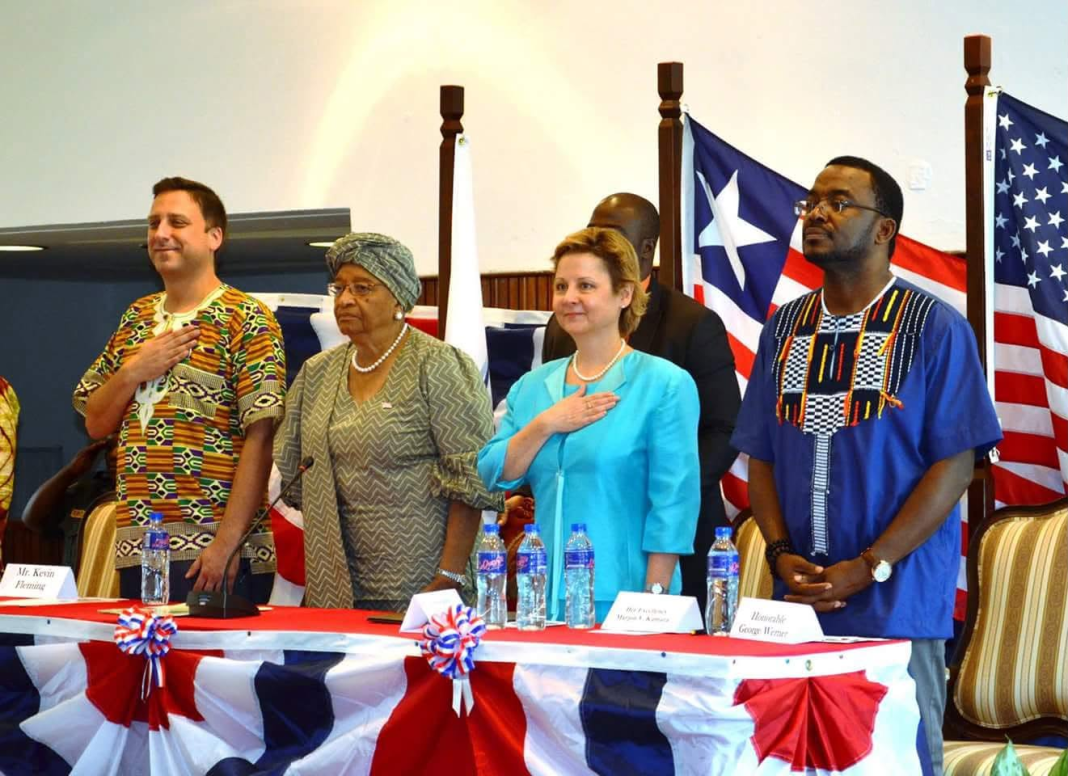
By George K. Werner (former education minister)
There is something weighing heavily on my mind.
A familiar conversation is quietly resurfacing in Liberia’s political discourse, and I believe it deserves a thoughtful response. It is a conversation I heard before—during the heat of the 2017 presidential elections.
At the time, some supporters of one political camp argued that they were better qualified to lead Liberia because they possessed advanced academic degrees, had held senior government positions, enjoyed international exposure, and belonged to the country’s political establishment. Some even referred to themselves as “the majority of sound-thinking Liberians.” The implication was unmistakable: those who supported the opposing candidate were somehow less informed, less intelligent, or less capable of making sound political judgments.
I rejected that argument then with a simple but impactful social media post that many Liberians still remember:
“Da book we will eat?”
It was not an attack on education. Anyone who knows me understands that. I have devoted much of my professional life to education—as Minister of Education, as an advocate for education reform, and today through my work to strengthen teaching and learning across Africa. Education transforms lives. Degrees matter. Experience matters. Exposure matters.
But in a democracy, none of these gives anyone an automatic entitlement to govern. Political legitimacy comes from one place and one place only: the freely expressed will of the people.
Nearly a decade later, I hear the same elitist thinking returning in a different form. Some now argue that former President Ellen Johnson Sirleaf somehow “forced” George Weah upon Liberia in 2017. According to this narrative, millions of Liberians merely endorsed a decision that had already been made for them.
That assertion is not only historically inaccurate. It is profoundly disrespectful to the Liberian people.
The facts tell a different story.
The 2017 election came after twelve consecutive years of Unity Party rule. Whether one believes those years were successful or disappointing, there was a widespread desire among many Liberians for political change. Citizens across the country wanted an opportunity to chart a different course.
The official results of the National Elections Commission reflected that national mood. In the first round of the 2017 presidential election, George Weah received 596,037 votes, or 38.37 percent, while Vice President Joseph Boakai received 446,716 votes, or 28.76 percent. Because no candidate obtained more than 50 percent of the vote, the election proceeded to a runoff.
In that runoff, George Weah received 732,185 votes, or 61.54 percent, defeating Joseph Boakai, who received 457,579 votes, or 38.46 percent—a decisive margin of 274,606 votes.
Those votes were not cast by one former president.
They were cast by Liberians—from Cape Mount to Maryland, from Lofa to Grand Kru—who exercised their constitutional right to choose their leader.
Whether one agreed with that choice is beside the point. Democracy requires us to respect it.
The same democratic principle was tested again in 2023.
The first round produced one of the closest presidential elections in Liberia’s democratic history. George Weah received 804,087 votes, or 43.83 percent, while Joseph Boakai received 796,961 votes, or 43.44 percent, a difference of only 7,126 votes. Again, no candidate secured an outright majority, requiring a runoff.
This time, the Liberian people made a different choice. Joseph Boakai received 814,481 votes, or 50.64 percent, while George Weah received 793,914 votes, or 49.36 percent, giving Boakai victory by 20,567 votes.
Now let me ask a simple question.
Did George Weah impose Joseph Boakai on Liberia?
Of course not.
President Weah accepted the certified results announced by the National Elections Commission, congratulated his opponent, and peacefully transferred power. His conduct strengthened Liberia’s democratic reputation, but it did not determine who became President.
The Liberian people did.
If it is unreasonable to argue that George Weah imposed Joseph Boakai on Liberia in 2023, then it is equally unreasonable to claim that Ellen Johnson Sirleaf imposed George Weah on Liberia in 2017.
The principle cannot change depending on whether we like the outcome.
In both elections, Liberians voted.
In both elections, Liberians decided.
In both elections, power changed hands because citizens spoke through the ballot box.
There is another reason why this conversation matters.
According to the 2022 Liberia Population and Housing Census, only 58.6 percent of Liberians aged 15 years and above are literate. Literacy among young people aged 15 to 24 has improved to about 75 percent, reflecting encouraging progress in education, but millions of Liberians have had limited educational opportunities.
Yet our Constitution does not reserve the right to vote for university graduates.
It does not require a diploma before someone can choose a president.
Every Liberian citizen who is at least 18 years old has the same constitutional right to vote.
The market woman has one vote.
The farmer has one vote.
The fisherman has one vote.
The motorcycle rider has one vote.
The professor has one vote.
The lawyer has one vote.
The doctor has one vote.
The street vendor has one vote.
No vote counts more because its owner possesses a doctorate.
No vote counts less because its owner never had the opportunity to complete school.
That is the genius of democracy. It recognizes the equal political dignity of every citizen.
When we suggest that one influential politician “made” a president, we do more than rewrite history. We tell ordinary Liberians that their votes did not matter. We tell market women they were merely spectators. We tell farmers someone else made the decision. We tell young first-time voters that their participation was meaningless.
Nothing could be more damaging to our democracy.
The same is true when we divide Liberians into the so-called “sound-thinking” and the supposedly less enlightened.
The Constitution recognizes no such distinction.
Democracy recognizes no such distinction.
A professor’s ballot is worth exactly the same as a petty trader’s ballot.
A lawyer’s vote carries no greater constitutional weight than that of a rubber tapper.
A minister’s vote is equal to that of a taxi driver’s.
Political equality is not a slogan.
It is the foundation of our Republic.
History teaches us that education is invaluable, but it does not guarantee wisdom, integrity, humility, or effective leadership. Nor does the absence of elite credentials disqualify someone from earning the confidence of the people.
The ballot box exists because no individual, no political party, and no educated elite possesses a monopoly on wisdom.
The people decide.
Perhaps that is what my question in 2017 was really about.
“Da book we will eat?”
No.
We do not eat degrees.
We do not eat political pedigree.
We do not eat elite approval.
We live by something far more important.
We live by the sovereign will of the Liberian people.
And in a democracy, there is no higher authority than that.

