

The Government of Liberia is weaving together women’s economic empowerment, education, and social protection as interconnected pillars of its national development strategy — a move designed to reduce poverty, strengthen families, and accelerate transformation.
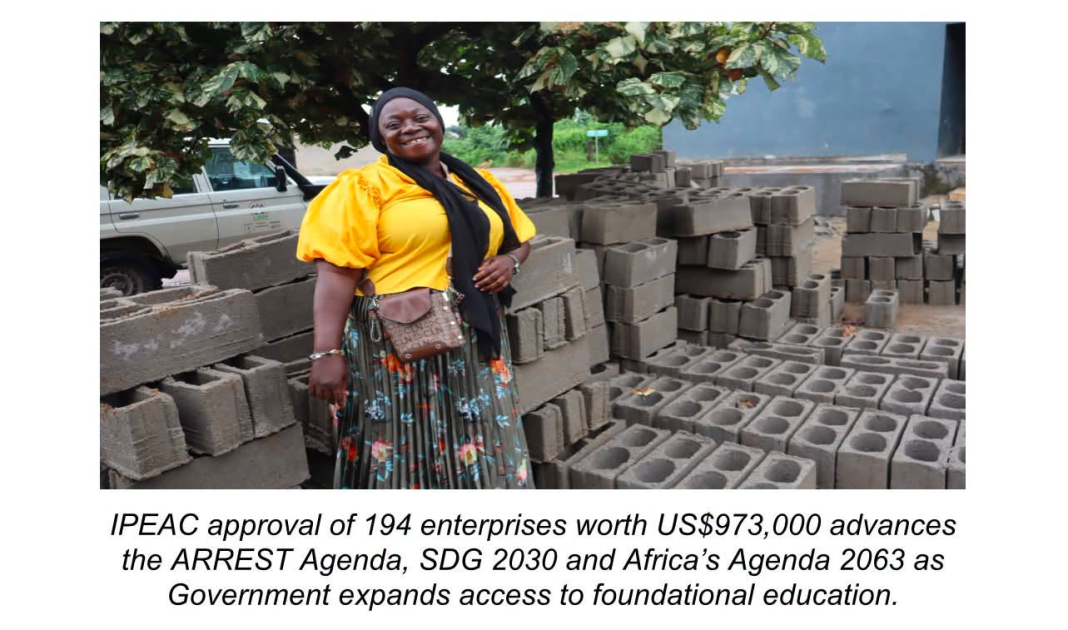
Through the Ministry of Gender, Children and Social Protection (MGCSP) and the Liberia Women Empowerment Project (LWEP), the Independent Proposal Evaluation and Approval Committee (IPEAC) has recommended 194 enterprise and livelihood grant applications valued at nearly US$1 million. The grants, totaling US$973,000, emerged from a rigorous review of 202 proposals submitted across Bomi, Grand Cape Mount, and Rural Montserrado Counties.
This announcement comes on the heels of President Joseph Nyuma Boakai’s landmark policy declaring free education from Kindergarten/Grade Zero through Grade 6. By removing foundational education costs, the government aims to ease financial burdens on parents and guardians while ensuring more children remain in school.
Together, these interventions underscore how investments in women’s livelihoods and children’s education can reinforce one another: stronger household incomes paired with reduced education expenses create a cycle of resilience and opportunity.
At the 7th IPEAC sitting, 202 business plans were independently evaluated. Of these, 194 were approved, seven recommended for revision, and one rejected. The portfolio includes 128 Individual Enterprises (IEs), 65 Village Savings and Loan Associations (VSLAs), and one Farm-Based Organization (FBO).
Funding allocations are significant: US$317,000 will be disbursed as single payments to the 128 IEs, while US$340,000 will be released to the VSLAs and FBO as their first 50-percent tranche. Beyond the numbers, these grants represent women, families, and communities whose enterprises can evolve into stronger sources of income, savings, employment, and resilience.
For many Liberian households, small business earnings must stretch across food, healthcare, transportation, business expenses, and children’s education. Eliminating foundational education costs allows families to redirect scarce resources toward other essentials and productive investments.
For women entrepreneurs receiving LWEP support, reduced education expenses mean more capital can be reinvested in inventory, farming, processing, or household welfare. For men and other caregivers, the policy similarly eases financial pressure, enabling families to jointly invest in both children’s education and household economic security.
The connection is clear: stronger enterprises increase household income; reduced education costs protect that income; and improved access to schooling strengthens the productive potential of the next generation.
These interventions align with President Boakai’s ARREST Agenda for Inclusive Development, Liberia’s five-year national framework emphasizing human capital, education, gender and youth empowerment, livelihoods, infrastructure, governance, and inclusive growth. LWEP’s investment in women-led enterprises is not merely about grants — it is about building economically productive citizens and communities capable of driving transformation. Simultaneously, free foundational education strengthens the human-capital base required for long-term national progress.
Liberia’s dual investment in women’s enterprises and education directly contributes to the United Nations Sustainable Development Goals (SDGs), particularly SDG 1 (No Poverty), SDG 4 (Quality Education), SDG 5 (Gender Equality), SDG 8 (Decent Work and Economic Growth), and SDG 10 (Reduced Inequalities).
A woman gaining access to productive capital is not simply receiving a grant — she is strengthening her ability to generate income, support her children’s schooling, build savings, and participate more effectively in her local economy. Likewise, reducing barriers to education ensures poverty does not dictate whether a child enters or remains in the classroom.
The approach also reflects the African Union’s Agenda 2063 vision of “The Africa We Want” — a prosperous continent built on inclusive growth, sustainable development, and full gender equality. Liberia’s strategy demonstrates how today’s empowerment initiatives can fuel tomorrow’s human capital.
The significance of the LWEP grants extends beyond the US$973,000 approved. Consider a household where a woman expands her enterprise with LWEP support while simultaneously benefiting from reduced education costs for her children. The result is a positive cycle: stronger enterprise, increased household income, reduced education burden, greater opportunity to keep children in school, more resources for business and household needs and stronger, more resilient families.
This is where women’s empowerment, men’s shared responsibilities, children’s education, and national development converge. As Liberia advances the ARREST Agenda, the challenge and opportunity lie in sustaining these connections — ensuring economic empowerment, education, social protection, and gender equality collectively improve family wellbeing and national transformation.
The 194 enterprises recommended for funding are not just grants. They are 194 opportunities to strengthen households, expand community economies, and build a generation better equipped to contribute to Liberia’s future. From enterprise to household, and from household to classroom, Liberia is investing in people as the foundation of national transformation.

