


By Festus Poquie
Eighteen years after Liberia created its main anti-corruption agency, the country has stronger laws and more watchdog institutions, but little evidence that graft has been decisively curbed.
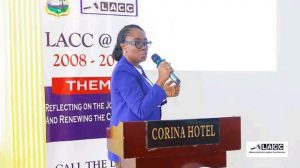
The Liberia Anti-Corruption Commission marked its anniversary this week by renewing its pledge to fight what officials once called Liberia’s “public enemy number one.” Yet the country’s modest improvement in Transparency International’s corruption index masks a deeper problem: investigations continue to outpace convictions, public funds remain difficult to trace, and the total financial cost of corruption is still unknown.
Liberia scored 28 out of 100 in Transparency International’s 2025 Corruption Perceptions Index, published in February 2026, ranking 136th among 182 countries. That was a one-point improvement from the previous assessment.
In 2008, the year the LACC was established, Liberia scored 2.0 on the index’s former 10-point scale — equivalent to 20 out of 100 — and ranked 138th among 180 countries. The country’s current position represents progress from the depths of the postwar period, but not a transformation in the way public resources are managed.
The Center for Transparency and Accountability in Liberia, or CENTAL, has described the latest gain as too small to reverse entrenched weaknesses in procurement, public financial management and the justice system.
“The fight against corruption cannot be measured only by the creation of institutions,” former President Ellen Johnson Sirleaf said at a national anti-corruption policy dialogue in in June. “An Anti-Corruption Commission that investigates but cannot see prosecution through to conviction is a commission that diagnoses the disease but fails to administer the cure.”
Missing billions
There is no official, comprehensive calculation of how much Liberia has lost to corruption since the LACC was created in 2008. The absence of such a figure reflects the difficulty of tracking off-budget spending, procurement fraud, unexplained allocations and illicit financial flows across multiple government institutions and administrations.
Civil-society and policy-monitoring estimates have sometimes put Liberia’s combined annual losses from corruption, tax evasion and illicit financial flows at as much as $1 billion. That figure is not a confirmed measure of corruption alone and should not be treated as an audited cumulative total.
The LACC reported that more than $13 million and 17 million Liberian dollars were involved in suspected losses or theft under investigation and state institutions in 2025. Those cases represent only identified matters under review, rather than the full cost of corruption during the year.
Audits by the General Auditing Commission have repeatedly flagged unaccounted-for funds and weaknesses in procurement and expenditure controls. Over time, such findings have pointed to losses amounting to hundreds of millions of dollars and billions of Liberian dollars. But because audit findings do not always result in recovery, prosecution or conviction, they cannot be simply added together to produce a reliable figure.
“Corruption is more than a legal problem,” UNDP Deputy Resident Representative Louis Kuukpen said at the LACC anniversary event. “It is a major development challenge that deprives citizens of essential services and weakens public trust.”
Liberia’s anti-corruption architecture has grown considerably since 2008. Alongside the LACC, the government strengthened the General Auditing Commission, the Public Procurement and Concessions Commission, the Liberia Extractive Industries Transparency Initiative, the Internal Audit Agency, the Financial Intelligence Unit, the Liberia Revenue Authority and the Independent Information Commission.
The LACC says it has hired professional investigators, lawyers and support staff, adopted internal procedures and conducted public education, investigations and prosecutions despite limited funding.
The most significant legal change came in 2022, when lawmakers amended the LACC Act to give the commission direct prosecutorial authority. Previously, the agency generally had to refer cases to the Ministry of Justice, a process critics said contributed to delays and weakened accountability.
The revised framework also established whistleblower and witness-protection legislation. It placed asset declarations for officials in all three branches of government under the LACC, replacing a more fragmented system in which the branches submitted declarations to separate authorities.
The changes give the commission more control over investigations and court proceedings. But implementation remains constrained by shortages of money, personnel and logistics, according to the agency.
Enforcement remains the test
For Liberia’s critics, the central issue is no longer whether the country has anti-corruption laws. It is whether those laws can be enforced against powerful officials and politically connected businesses.
Many corruption cases have stalled in the regular courts, where delays can stretch for years. Liberia still lacks a specialized anti-corruption court, while the LACC has called for the removal of the statute of limitations on corruption offenses.
Sirleaf, who established the LACC during her presidency, said the country was “falling short” in its fight against graft because investigations rarely end in convictions. She urged President Joseph Boakai, lawmakers and the judiciary to support a specialized court and protect the independence of accountability institutions.
“Corruption was largely an operating system” when she took office in 2006, Sirleaf said, adding that the institutions created since then had not produced enough enforcement to change public perceptions.
That gap between investigation and punishment has become a defining feature of Liberia’s anti-graft campaign. Announcements of probes can generate public attention, but the absence of final judgments and recovered assets has weakened confidence in the process.

