

Liberia’s leading opposition parties are laying the groundwork for a more coordinated challenge to President Joseph Boakai’s Unity Party government, turning disputes over the economy, corruption, governance, diplomacy and the country’s drug crisis into potential flashpoints ahead of the 2029 elections.
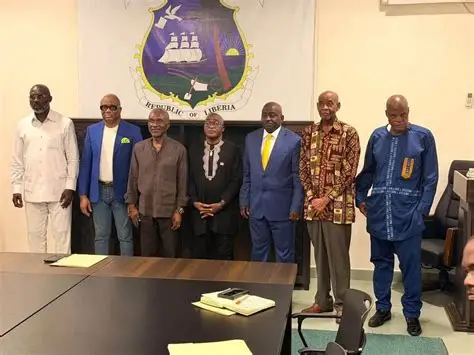
Former President George Weah’s Coalition for Democratic Change, Alexander Cummings’ Alternative National Congress, the Movement for Economic Empowerment, the Movement for Progressive Change and the Union of Liberian Democrats Party signed a joint communiqué on Sept. 27 committing themselves to sustained cooperation and a coordinated effort to hold the Boakai-Koung administration accountable.
The agreement creates a joint technical committee tasked with developing an operational agenda, policy positions and coordinated national advocacy. The parties said their objective is to build a broader, people-centered alternative while retaining their individual political identities.
Although the parties stopped short of declaring an electoral alliance or naming a common presidential candidate, the communiqué explicitly places their cooperation in the context of the 2029 general and presidential elections.
It calls for engagement with the National Elections Commission to help ensure what the parties describe as free, fair, transparent and inclusive elections.
The emerging opposition framework brings together Weah and Cummings, whose political differences have previously shaped Liberia’s opposition landscape, alongside MOVEE leader Dee-Maxwell Saah Kemayah, MPC leader Simeon Freeman and ULDP leader Jonathan Mason. The agreement gives the opposition effort a formal structure while leaving the question of any eventual electoral arrangement open.
This is how their manifesto and game plan for the 2029 political warfare would look like.:
Economy Becomes Central Battleground
Economic performance is one of the principal issues identified by the opposition.
The parties argue that increases in government revenue have not translated into sufficient improvements for poor Liberians, unemployed young people and small businesses.
They criticize what they describe as a difficult investment environment, limited access to credit and inadequate protection of economic opportunities reserved for Liberian businesses.
The opposition also targets government procurement, alleging that qualified Liberian-owned companies have been disadvantaged because of their political affiliations.
The government’s reported achievement of more than $1 billion in domestic revenue is acknowledged in the communiqué, but the opposition argues that the more important measure is the effect of public spending on ordinary Liberians.
That creates a potentially potent political issue for 2029: whether macroeconomic and revenue gains under Boakai have produced measurable improvements in household incomes, employment and private-sector activity.
Corruption Claims Put Government Under Pressure
Corruption is another major front.
The opposition is demanding investigations into a multimillion-dollar construction project in Foya, Lofa County, as well as an $8 million transfer from Liberia’s national reserves to SIB Liberia in 2024.
The Foya project has already attracted public scrutiny. The Alternative National Congress petitioned the Liberia Anti-Corruption Commission in May seeking an investigation into the project, citing concerns about procurement, financing and the use of public resources.
The government has described the Foya development differently over time.
President Boakai said in January that the project was fully owned by the Government of Liberia and linked it to a planned Mano River Union Presidential Center for Regional Peace and Development.
The opposition communiqué portrays the matter as evidence of what it calls selective enforcement of anti-corruption laws. It is calling for the LACC to investigate the allegations without political interference.
Cocaine Cases Become a Political Test
The handling of Liberia’s major drug seizures is likely to be another significant opposition talking point.
The five parties called for an independent investigation into drug seizures they identify as involving $19 million and $317 million worth of narcotics. They cited statements attributed to Police Inspector General Gregory Coleman concerning alleged involvement of senior government officials and questioned why some officials reportedly linked to the investigations have not faced prosecution.
The opposition is also criticizing what it describes as selective prosecution in drug-related cases and is proposing a broader investigative mechanism involving professional associations, civil society, religious organizations and members of the diplomatic community.
Diplomacy and Territory Enter the 2029 Debate
Foreign policy and national sovereignty have also emerged as political issues.
The opposition says Liberia has failed to respond adequately to what it describes as the loss of Liberian territory to Guinea in Foya District, Lofa County. It is demanding stronger diplomatic action through regional and international institutions, including ECOWAS, the African Union and the United Nations.
The parties also criticized the government’s handling of relations with the European Union, citing the March 2026 request for the recall of EU Ambassador Nona Deprez after her comments concerning transparency in Liberia’s mining sector.
The communiqué characterizes the episode as evidence of declining diplomatic relations and intolerance toward criticism. Those are political assessments by the opposition rather than independently established conclusions.
The parties also demanded greater transparency over an arrangement involving the transfer of up to 1,200 third-country nationals from the United States to Liberia, arguing that the public has not received sufficient information about the agreement.
Rule of Law and Free Speech
The opposition has made judicial independence and freedom of expression another pillar of its emerging platform.
The parties accuse the Boakai administration of disregarding Supreme Court opinions, interfering in the administration of justice and selectively prosecuting political opponents. They also criticize the use of Liberia’s cybercrime legislation, arguing that authorities could use the law to suppress legitimate political criticism.
The parties say their alternative would emphasize constitutional government, judicial independence, equal justice and protection of political speech.

