

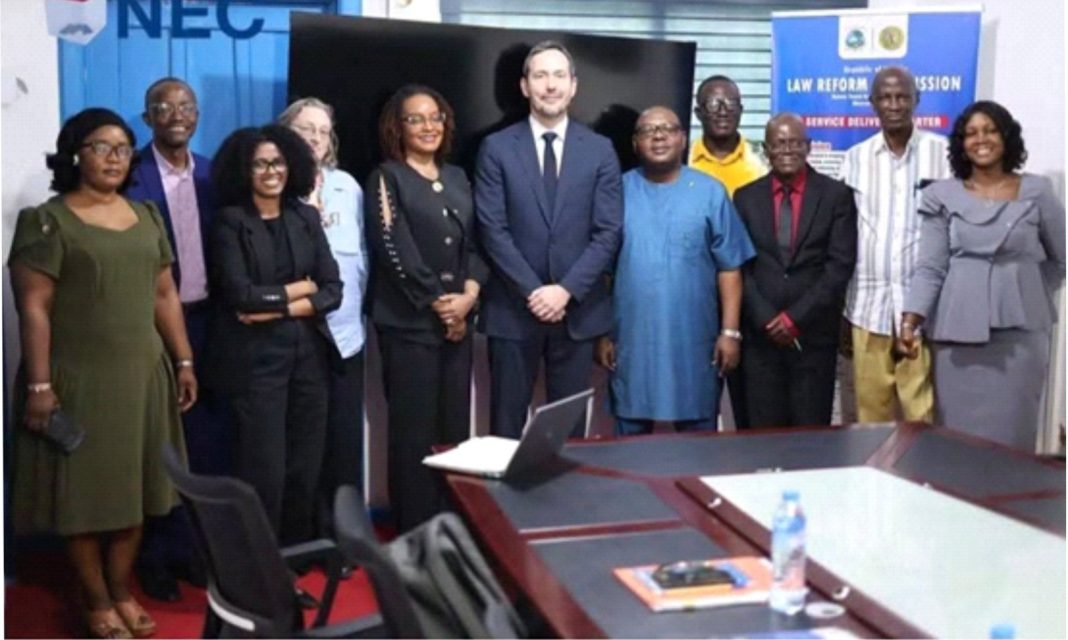
Liberia has intensified its drive to overhaul the nation’s electoral legal framework, with the National Elections Commission (NEC), the Law Reform Commission (LRC), the United Nations Development Programme (UNDP), and international electoral experts convening a high-level consultation in Monrovia.
The meeting marks a critical step toward validating a revised National Electoral Law before the end of 2026, ahead of the country’s next General and Presidential Elections in 2029.
The consultation, held Wednesday at the LRC headquarters and chaired by LRC Chairperson Cllr. Bornor M. Varmah, focused on preparations for the forthcoming Electoral Law Reform Validation Exercise. That exercise is expected to bring together government institutions, political parties, civil society organizations, election stakeholders, and international partners to examine and consolidate proposed amendments.
Participants included NEC Commissioners Boakai A. Dukuly and Cllr. Earnestine Morgan Awar; UNDP/Liberia Electoral Support Project Chief Technical Adviser Katherine Green and her team; and visiting UN Senior Electoral Affairs Officer Maarten Halff. The discussions build on nationwide consultations conducted with UNDP support and backed by partners including the European Union, Irish Aid, and Sweden.
According to the LRC, the reform process is examining several areas central to the credibility of future elections. Among the principal issues are voter registration, campaign financing, electoral dispute resolution, and women’s representation in the National Legislature.
The timing is significant: with Liberia preparing for the 2029 elections, institutions and stakeholders are under pressure to review, validate, and enact changes well ahead of the next nationwide electoral cycle. President Joseph Nyuma Boakai has reportedly expressed concern about the pace of reforms and instructed the LRC to accelerate the process.
Liberia’s electoral system has evolved considerably since the end of the civil wars, with the NEC administering successive presidential, legislative, and local elections. The 2023 presidential election underscored the scale of modern operations: 2.47 million registered voters, nearly 5,900 polling places, and a runoff that drew almost 79 percent turnout.
That contest highlighted the importance of clear procedures, effective dispute resolution mechanisms, and public confidence in the process. Against this backdrop, the proposed reforms could reshape rules governing voter registration, political financing, dispute resolution, and women’s participation in politics.
Women’s political representation remains a pressing issue. Liberia made history in 2005 when Ellen Johnson Sirleaf became Africa’s first elected female head of state, yet women’s presence in the legislature remains limited. Current Inter Parliamentary Union data shows women hold just 11 percent of seats in the House of Representatives and 10 percent in the Senate, with no statutory quota system in place.
Whether Liberia should adopt stronger legal mechanisms to improve women’s representation is expected to be a central component of the reform debate.
Campaign financing rules are also under scrutiny. Reform discussions could determine how Liberia regulates contributions, expenditures, disclosure, and enforcement. Electoral dispute resolution is equally critical, with reforms expected to clarify procedures for complaints, challenges, and appeals to reduce uncertainty during and after elections.
Beyond legislative changes, Liberia’s reform agenda includes institutional and operational improvements. In July 2026, UNDP reported that the NEC had launched a technical consultation based on a capacity assessment, aimed at developing a reform roadmap under its 2026–2030 Strategic Plan. That plan seeks to improve efficiency, strengthen accountability, and build public confidence.
Earlier in May, the NEC and UNDP conducted a nationwide workshop on field operating procedures to enhance decentralized administration, logistics, reporting systems, and evidence-based decision-making.
The planned validation exercise will consolidate recommendations from consultations into a framework for consideration. Its significance lies in determining whether proposals reflect the concerns of electoral institutions, political parties, civil society, women and youth organizations, and legal experts.
For Liberia, the challenge will be translating consultation outcomes into clear, enforceable, and broadly understood electoral rules sufficiently ahead of the 2029 elections.
As the country moves toward another major electoral cycle, the reform process places renewed focus on four fundamental questions: who is registered to vote, how campaigns are financed, how disputes are resolved, and how broadly Liberians are represented in elected institutions.
The outcome of these consultations and the eventual validation process could shape Liberia’s electoral framework for years to come.

