

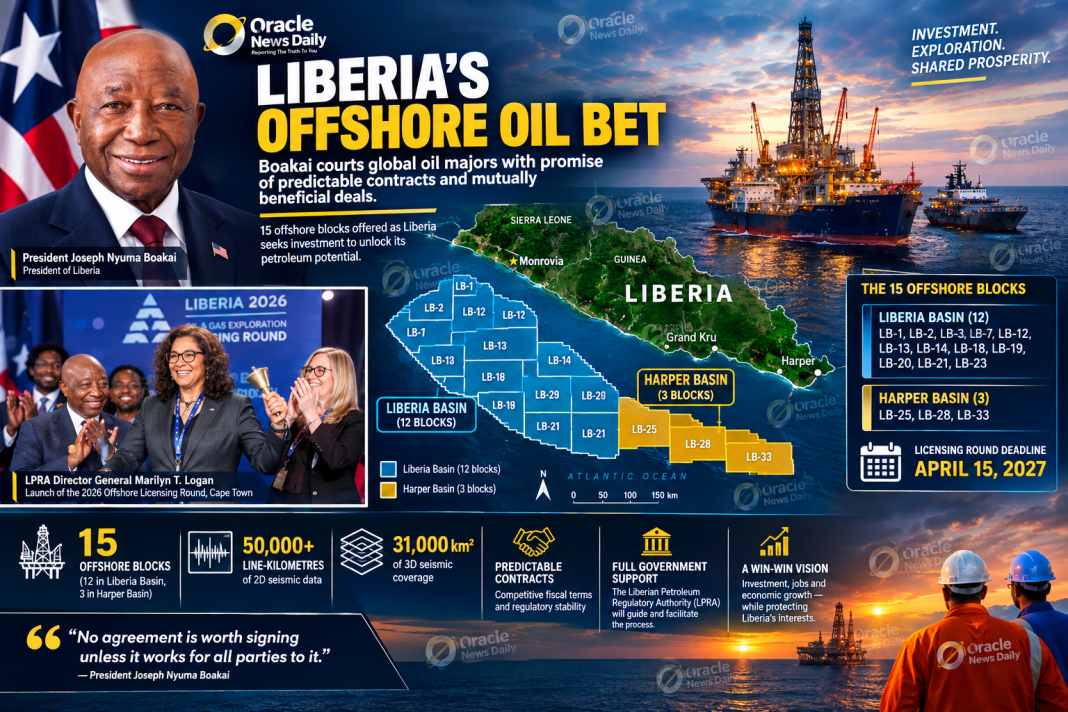
Liberia is offering 15 offshore oil exploration blocks to international petroleum companies, seeking to attract fresh investment with assurances of predictable contracts while insisting that any agreements deliver benefits to both investors and the West African nation.
President Joseph Nyuma Boakai’s administration is pitching the licensing round as an opportunity for oil companies to enter a frontier exploration market under a framework designed to provide contractual stability, competitive fiscal terms and clear
exploration obligations.
The 2026 Offshore Direct Negotiation Licensing Round, launched Wednesday by the Liberia Petroleum Regulatory Authority (LPRA) at African Energy Week in Cape Town, covers 12 blocks in the Liberia Basin and three in the Harper Basin. The process is scheduled to close on April 15, 2027.
Boakai said his government would support investors pursuing opportunities through the regulator, while emphasizing that contractual certainty must be matched by agreements that protect Liberia’s interests.
“No agreement is worth signing unless it works for all parties to it,” the president said in a video message at the launch.
The statement captures the administration’s central challenge as it seeks to attract international oil majors to an offshore sector that has yet to establish commercial production: persuading companies to commit capital to exploration while ensuring that Liberia secures an acceptable share of any eventual economic benefits.
“Today, I assure you that the journey you are about to begin with Liberia—through the LPRA—carries the full support of the Liberian government,” Boakai said.
Exploration Push Targets International Capital
The licensing round expands Liberia’s efforts to revive offshore exploration and build on renewed interest in its petroleum sector.
The 15 blocks on offer are LB-1, LB-2, LB-3, LB-7, LB-12, LB-13, LB-14, LB-18, LB-19, LB-20, LB-21 and LB-23 in the Liberia Basin, and LB-25, LB-28 and LB-33 in the Harper Basin.
For prospective investors, the opportunity comes with the geological uncertainty inherent in frontier exploration. Companies must commit substantial capital to seismic analysis, drilling and other technical work before establishing whether commercially recoverable oil exists.
LPRA Director General Marilyn T. Logan said geological and geophysical evidence supported the case for further exploration, urging qualified companies to submit letters of intent before the April deadline.
“Our petroleum system works,” Logan said. “Whichever company makes the first discovery will play a significant role in the history of our country.”
The regulator is seeking to distinguish companies prepared to undertake exploration from those that might secure acreage without advancing it. Under its “Explore or Release” principle, companies must meet their contractual exploration commitments or relinquish blocks in accordance with their agreements and applicable law.
The policy is intended to keep offshore acreage available for serious exploration and discourage speculative accumulation of exploration rights.
Predictability in the fiscal and regulatory framework is a key part of Liberia’s pitch to international oil companies, which typically evaluate not only geological prospects but also the terms under which they can develop and monetize discoveries.
LPRA Deputy Director General for Finance Robert Sonkarlay said Liberia’s fiscal framework was designed to offer competitive terms while providing the stability required for long-term investment.
“Investors are not just looking to find attractive fiscal terms; they’re also looking for fiscal predictability,” Sonkarlay said.
Under the direct negotiation framework, prospective companies must demonstrate financial capacity, technical competence and relevant offshore exploration experience. Qualified applicants can then negotiate block-specific exploration programs and contractual arrangements under Liberia’s Petroleum Exploration and Production Act of 2014, as amended in 2019.
LPRA Board Member Cllr. Kou Dorliae said the authority was also seeking to make engagement with prospective investors more predictable. Prequalification remains valid for five years, allowing eligible companies to pursue opportunities during that period.
To support the offering, Liberia is presenting prospective investors with an extensive collection of geological and geophysical data intended to improve assessments of its offshore prospects.
The available information includes more than 50,000 line-kilometers of two-dimensional seismic data and about 31,000 square kilometers of three-dimensional seismic coverage.
Technical data provider TGS has also reprocessed approximately 12,000 kilometers of 2D seismic data and 5,100 square kilometers of 3D data to improve subsurface imaging.
The information is intended to help companies evaluate geological structures and refine their exploration strategies before committing to expensive offshore drilling campaigns.
Jason Robinson, managing director of geoscience specialist ENARJI, said geological evidence pointed to a working petroleum system offshore Liberia, with deepwater exploration opportunities along the Atlantic margin.
Such assessments can help attract investor interest, although evidence of a functioning petroleum system does not by itself establish the presence of commercially recoverable reserves.
Liberia Builds on Earlier Agreements
The new offering follows Liberia’s conclusion of eight petroleum production-sharing contracts with TotalEnergies and Atlas Oranto Petroleum in 2025, according to the LPRA.
The agreements marked a step in renewed international engagement with the country’s offshore petroleum sector, providing a backdrop for the latest effort to attract additional exploration companies.
Preparations for the 2026 licensing round included an investor engagement event in Houston, Texas, on Aug. 19, followed by the opening of the prequalification process on Aug. 28.
The latest round is intended to broaden that engagement and bring more qualified companies into negotiations over exploration rights.
However, securing investor interest is only the beginning. Converting licensing agreements into exploration activity will depend on companies’ willingness to commit capital, the results of geological assessments and the commercial prospects of any discoveries.

