

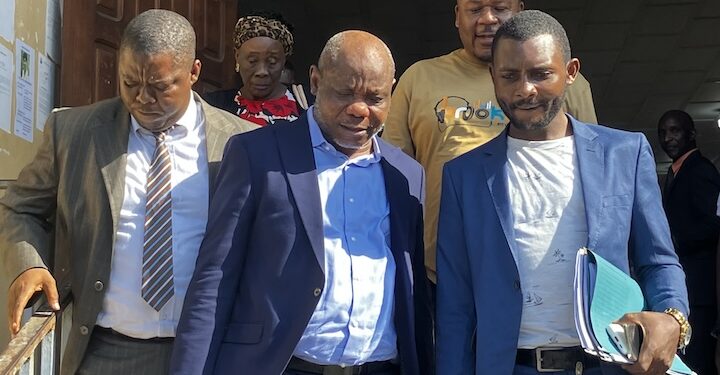
In a courtroom that has, for weeks, resembled both a civic forum and a theater of high stakes, the prosecution’s case against former Finance Minister Samuel D. Tweah, Jr. and four members of the National Security Council has apparently collapsed under the force of the man at its center.
After four days of testimony from Tweah — lucid, technical, and at times visibly moved — prosecutors scrambled to file motions for rebuttal witnesses, a procedural sign more often associated with desperation than with confidence.
The drama that has played out before Judge Ousman Feikai is not simply a contest of fact. It is a collision of institutional narratives: a prosecution built on inferences and missing formalities, and a defense that has methodically converted arcana of public finance into plain, persuasive storytelling.
Where the indictment alleged theft, money laundering and conspiracy—charges that depend heavily on proving lack of authority and the conversion of public funds into private use—Tweah supplied context, statutory scaffolding and procedural examples that repeatedly punctured the prosecution’s claims.
For a minister who has described the trial in public as a “witch-hunt,” the effect in court has been the opposite of bluster.
Tweah’s demeanor was part lecturer, part imperious. He explained to a jury of twelve what he called the “legal trigger” for movement of budgeted funds: the passage of the National Budget. He walked jurors through the contours of Liberia’s Public Financial Management law — allotments, reallotments, delays, the minister’s discretion to prioritize payments — until what had sounded like administrative jargon became, in the judge’s chamber, the anatomy of legal authority.
Central to the prosecution’s case was a narrow contention: that Tweah lacked legal authority to approve transfers totaling more than LRD$1.05 billion and US$500,000, and that those transfers, dispatched in part to the Financial Intelligence Agency (FIA), were therefore illicit.
Tweah’s counterpunch was surgical. He argued that the National Security Council’s approval of the National Joint Security budget for 2023, combined with PFM statutes that allow the finance minister broad discretionary powers in exigent or emergency circumstances, sufficed to authorize the disbursements.
He reminded jurors that written requests are common but not determinative: in emergencies, money can and does move on the minister’s authority, and the law contemplates that reality.
He illustrated the point with concrete examples that have the ring of lived governance: the National Elections Commission received tens of millions of dollars via direct debit months before the 2023 elections, a transfer Tweah said was insisted upon by development partners who feared delays in the domestic budget process.
The transfers, he argued, were lawful, documented in treasury instruments and reflected in the government’s 2023 expenditure report. If direct debit could fund an entire national election without scandal, he asked, why should a transfer to the FIA be treated as a unique aberration?
That line of argument did more than explain the mechanics of public finance. It exposed a deeper fault line in the prosecution’s approach.
Much of the state’s case had been assembled from investigative reports, hearsay and the testimony of a lead investigator, Baba Borkai of the LACC, whose accounts the defense picked apart for inconsistencies.
Tweah’s cross-examination highlighted contradictions between the LACC’s final report, the indictment and live testimony, rendering the narrative of conspiracy brittle.
On repeated occasions he invited jurors to consider simple possibilities the prosecution had not: that agency membership in the National Joint Security was automatic under the 2011 National Security Reform Act; that written directives are not the only means by which acting ministers acquire authority; that the presence of an authorizing letter from one official to another is not, by itself, dispositive.
Perhaps the most damaging thrust came when Tweah turned the prosecution’s evidentiary posture against itself. He repeatedly emphasized the prosecution’s failure to show any traceable personal enrichment: no new properties, no suspect bank accounts, no receipts linking large withdrawals to private benefit.
“Money moving between government accounts is not whitening dirty cash,” he told jurors, borrowing the French locution for money laundering to make a colloquial point: transfers among government entities do not equate to criminal laundering merely because prosecutors label them so.
The courtroom’s emotional register shifted as well. Tweah’s testimony was technical, but it was also human: he choked up recounting the moment he learned that an arrest warrant had been falsely announced on national radio, the embarrassment and fear that rippled through his family, the peculiar indignities of an airport interrogation.
Those flashes of vulnerability — paired with his lucid dismantling of the prosecution’s theory — did more than sway spectators. They supplied a narrative frame in which the defendants’ actions could be read as accountable governance under strain, not as a criminal conspiracy.
The prosecution’s response, so far, has been procedural rather than persuasive. Faced with an opponent who spoke from experience and paperwork, prosecutors filed motions for rebuttal witnesses — an acknowledgement that their original witness roster has failed to neutralize Tweah’s claims.
But the question now is what kind of witness can repair proofs the minister made from firsthand practice: an expert on statutes? Another former minister?
The risk for the state is that opinion testimony may lack the immediacy of lived policymaking and therefore fail to persuade a jury that has already heard concrete examples of how the budget and emergency disbursements operate.
Two other contested factual pillars were exposed during testimony. First, the prosecution’s insistence that the FIA was not a member of the National Joint Security turned out to be a precarious assertion.
The defense produced statutory text and traced the FIA’s institutional lineage back to a post 2011 regulatory architecture that, by statute, renders later-established law-enforcement bodies automatic members of the security apparatus.
Second, the prosecution’s reliance on a July 2023 letter from a National Security adviser as proving “formal” admission of the FIA misread institutional practice: Tweah and his counsel distinguished between “institutional” membership and the personal “oath of secrecy” sometimes administered to new officials. The distinction is arcane; in court it proved decisive.
The scene in the courtroom now is one of a prosecution forced to improvise. While legal teams litigate credibility in daily skirmishes before jurors, the broader story is clearer: a case once presented as a straightforward account of misuse of public funds has become a contest over legal authority, statutory interpretation and institutional custom. In that struggle, the defendant who knows both the statutes and how the machinery of state actually runs has gained the upper hand.
How this will play to a jury remains to be seen. Legal analysts who have watched the trial — law students, local commentators and the occasional veteran practitioner — conceded that Tweah’s testimony has been devastating to the prosecution’s theory.
But criminal trials are capricious institutions where doubt, instruction and summation still have work to do. The prosecution’s move to seek rebuttal witnesses signals a refusal to concede.

