

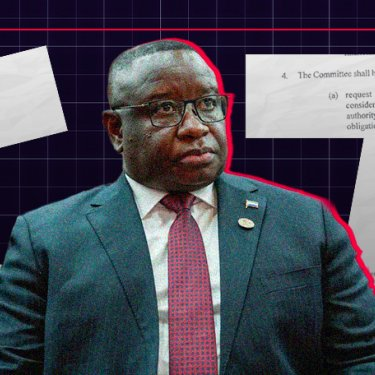
The new anti-terrorism law passed by parliament could allow Sierra Leone’s judicial authorities to impose heavy prison sentences on journalists and restrict access to information in the name of national security. Reporters Without Borders (RSF) calls on President Julius Maada Bio not to enact this legislation until it explicitly guarantees journalists’ protection. The NGO has released four recommendations to prevent the law from becoming a tool for abuse.
Sierra Leone is ranked in the top third of the 2025 World Press Freedom Index, coming in 56th out of 180 countries and territories — yet a new piece of legislation against terrorism could pave the way for an unprecedented crackdown on the press. The vaguely worded bill, passed by parliament on 11 March, gives the state broad powers, which could be used to silence journalists critical of the authorities if signed into law by President Julius Maada Bio.
Although Sierra Leone has not experienced any attacks by terrorist groups in recent years, the president has described several episodes of internal violence — notably the August 2022 protests against the high cost of living and the outbreaks of violence during the Covid-19 pandemic — as “terrorist” acts. He notably accused the main opposition party, the All People’s Congress (APC), of inciting the clashes, raising fears that the future law would be used to suppress dissenting voices.
The new legislation states — in imprecise terms — that a “terrorist act is committed when an act of violence or threat of violence (…) is prejudicial to national security or public safety (…).” What constitutes these acts and threats of violence is at the discretion of the judicial authorities as the text’s articles do not provide clear definitions, only vague bans”. This opaque wording could expose journalists reporting on sensitive or controversial subjects to prosecution simply for doing their job. The penalties for journalists provided by this legislation include up to 30 years in prison.
This law puts journalists in Sierra Leone under a blanket of repression. If it comes into force, it risks exacerbating the climate of fear and self-censorship that undermines Sierra Leonean journalists, particularly those investigating political and security issues, topics of public interest. This would be a fatal blow not only to press freedom but also to citizens’ right to reliable information. RSF calls on President Julius Maada Bio not to enact this law until it guarantees clear, firm protections for media professionals.
Sadibou Marong
Director of the RSF Sub-Saharan Africa Bureau
The current wording of several of the bill’s provisions are troubling: article 32(f), for example, provides for a 15-year prison sentence for “giving information” that the author “knows or has reasonable grounds to suspect to be false,” with no further details. No exception is made for the publication of journalistic information of public interest, which could lead to the arbitrary targeting of reporters.
Article 21 prohibits the distribution and circulation of a publication “with intent to provide encouragement (…) for the instigation, preparation or commission of an act of terrorism and carries a minimum sentence of 25 years’ imprisonment, while Article 22 could provide the state with a reason to step up online censorship by including a severe prison sentence and heavy fine for “distributing, sharing or disseminating” online materials “linked to a terrorist, a terrorist group, terrorist entity.”
Meanwhile, article 4 of the bill poses a serious threat to the protection of sources, a fundamental principle of independent journalism, by allowing the authorities to “request and obtain information (…) from any person or authority, for the purpose of discharging its obligations under this Act.”
In order to prevent the anti-terrorism law from being used to criminalise journalism, RSF recommends the following revisions to the text before the law is enacted:
- Amend the definition of “terrorist act” to explicitly exclude journalistic work of public interest, which will prevent abuses against journalists;
- Revise Articles 21, 22 and 32(f) to introduce an exemption for journalists or, at minimum, a clause enabling journalists to prove their intention was to inform the public and not to promote terrorism;
- Amend Article 4 to guarantee the confidentiality of journalists’ sources;
- Remove prison sentences for publishing false information.
- RSF

