

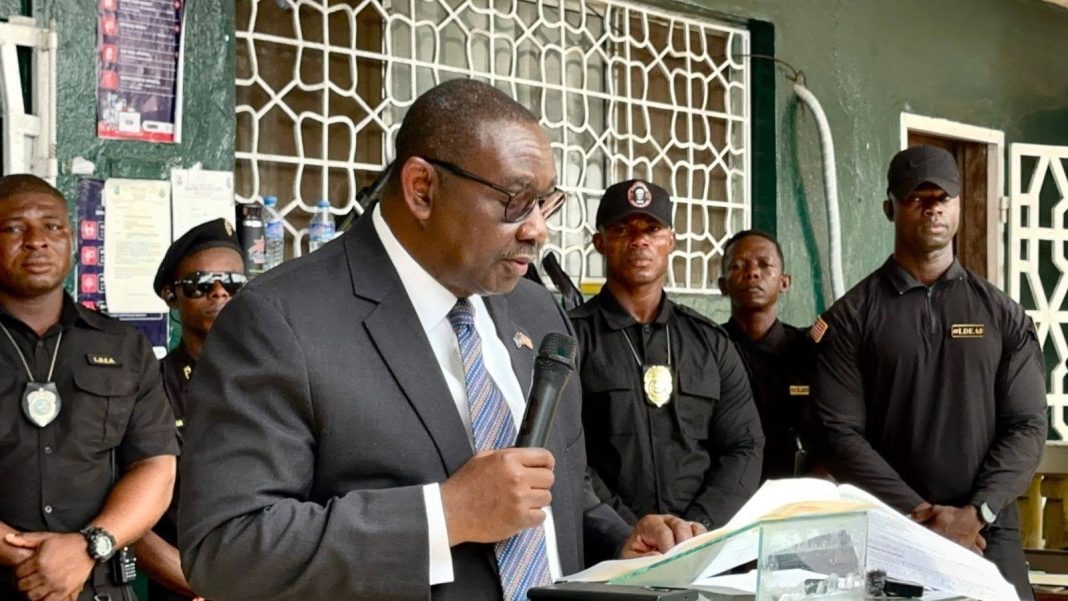
New details emerging in the June 8 narcotics seizure at Roberts International Airport suggest multiple high-ranking officials, including senior security chiefs, may be entwined with an international cocaine-trafficking network that has targeted the country in recent years.
A transnational drug pipeline leveraged Liberia’s strategic logistics and governance gaps to facilitate moves of cocaine into and through West Africa with a potential $15 million kickback linked to policy decisions or operational directives that could have aided drug trafficking activities, according to people privy to the matter.
The 198 kilograms of cocaine intercepted at the airport, originated from Colombia, reached Liberia via sea and destined for the United Kingdom via Brussels Airlines.
US intelligence agencies tracked the movements and hoping to affect the confiscation in the UK but suddenly lost trail when consignments were assigned a diplomatic coding. His approach by the Liberian enablers would have disabled interception in the UK as planned, thereby triggering Washington and allies to hit the alarm bell in Monrovia.
According to people familiar with the investigation officials entered a thirty percent (30%) kickback deal with the cartel to facilitate the passage of the narcotics. With the market value of narcotic moving from the US$19.2 million official figure to US$50 million, sleezy officials and accomplice’s ma have benefit millions of dollars in illicit shipments.
The underpinning rationale, according to sources, is that the drugs are merely “passing through” and are not intended for the local market, a claim that provides little comfort, as the nation’s reputation remains in jeopardy.
On Tuesday Liberia’s Justice Minister and Attorney General, Cllr. Oswald old House hearing the government is deliberately withholding details of the country’s largest-ever drug bust to safeguard the integrity of the investigation.
Speaking to members of the House of Representatives, Tweh insisted that disclosing sensitive information about the US$19.2 million cocaine seizure could jeopardize ongoing inquiries and compromise international intelligence-sharing. “As investigators continue their work, we are withholding details from the public to protect the integrity of the process,” he declared.
The Attorney General emphasized that Liberia’s limited investigative capacity makes discretion essential. He warned that exposing classified information could set a dangerous precedent, undermining future cooperation with foreign partners and allies. “We must protect the information entrusted to us through international collaboration,” Tweh argued, stressing that transparency must be balanced against national security concerns.
Lawmakers pressed Tweh on the whereabouts of Emmanuel Zeon, the only individual publicly linked to the case thus far. His response stunned the chamber: “We don’t know whether Emmanuel Zeon is dead or alive.” The admission has fueled speculation and heightened public anxiety over the government’s handling of the case.
Meanwhile, the Liberia Drug Enforcement Agency (LDEA) has expanded its probe to include a separate 100kg shipment of cocaine transshipped from Roberts International Airport (RIA) to the United Kingdom on May 22, 2026. Investigators have petitioned the Court to subpoena RIA management for all closed-circuit television (CCTV) footage covering May 22 through June 8, 2026.
This move follows revelations by investigative journalists who released classified documents, including waybills for both the 233kg and 100kg consignments. The disclosures have intensified pressure on authorities to explain how such massive quantities of narcotics could pass through Liberia’s premier airport undetected.
A writ of subpoena issued by Resident Circuit Judge Victoria Worlobah Duncan of the 13th Judicial Circuit Court in Kakata, Margibi County, commands RIA management to appear before the court on June 22, 2026. The order demands production of shipping waybills, supporting documents, and all CCTV footage relating to incidents on May 22 and June 5–8, 2026. “You are hereby commanded… to produce all closed-circuit television (CCTV) video footage bordering and relating to the incidents… involving substances discovered in boxes believed to be narcotic substances (cocaine),” the writ states.

