

BY TANGI BIHAN & KEÏSHA CORANTIN / Le Monde
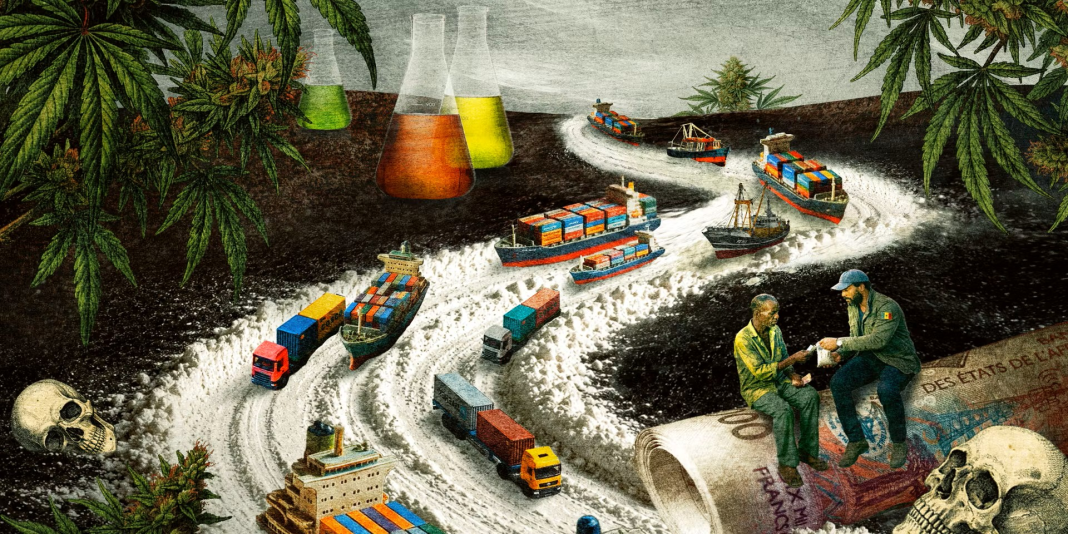
VAST quantities of cocaine are increasingly being seized off the coast of West Africa. In March 2024 the French navy, which is active in the region as part of the joint maritime security mission Operation Corymbe, captured 10.7 tonnes of the drug from a fishing boat from Brazil sailing in international waters in the Gulf of Guinea.
In September 2025 the navy intercepted a shipment of 9.6 tonnes in the same area. Long before that, in 2019, authorities in Cape Verde captured 9.5 tonnes from a cargo ship from South America bound for the Moroccan port of Tangier. The value of each of these shipments is estimated at over $580m.
The volume of South American cocaine being transported to Europe via West Africa has skyrocketed since trafficking began in the late 1990s.
While seizures reflect the number and effectiveness of surveillance operations more than the actual volumes trafficked, the figures highlight a trend: between 2012 and 2018, less than two tonnes of cocaine was found across West Africa each year. Between 2019 and 2025 ten times that quantity was seized.
This increase reflects a global trend, and the unprecedently high levels of trafficking. In South America, and especially Colombia, which is by far the world’s leading producer of coca, output has been growing for roughly a decade.
The potential output of refined cocaine has increased from less than 900 tonnes a year in 2013 to almost 4,000 tonnes today, driven primarily by an uptick in global consumption.
If the flow of the drug from producers to consumers is increasing, the percentage which passes through West Africa is growing even faster.
Experts estimate that at least a third of the cocaine destined for Europe passes through this region. But why has West Africa become such a major transit hub?
In a recent report, the NGO Global Initiative Against Transnational Organised Crime (GI-TOC) put forward several explanations. First, European and Latin American states have boosted police operations along the direct shipping lane, leading to a clear increase in seizures (200 tonnes captured in 2019 and more than 400 tonnes in 2023). This has encouraged traffickers to use West African routes instead.
Huge rise in container traffic
The growth in global trade has prompted an expansion of major ports to handle the massive rise in container traffic (up 57% between 2010 and 2022), which means there are more opportunities to conceal cocaine.
Monitoring capacity has not kept pace: on average less than 2% of containers are inspected, and this is also the case in Europe. In addition, according to the report, West Africa offers a favourable environment for illicit trade: thanks to corruption, traffickers can secure ‘protection’ through state actors at multiple levels. The report also notes that ‘although routings through West Africa may be longer than direct routes, they are more secure, with a lower risk of seizure’.
This sharp rise in the quantity being shipped has been accompanied by a shift in traffickers’ methods. Cocaine, which was traditionally concealed among the legitimate cargo on board container ships to reach West Africa, is now increasingly transported by other means, such as fishing boats. So the drug can be transferred at sea into several smaller vessels which then land it along the coast.
‘It is very difficult to control a maritime border, especially for countries with limited budgets and operational capacities,’ notes François Patuel, head of the West and Central Africa Research and Awareness Unit at UNODC. ‘Faced with a difficult economic climate – as development aid declines and technical partners withdraw – some states struggle to obtain the equipment needed for maritime surveillance or drug detection and interception.’ Cocaine can then be sent to Europe through major West African ports in containers or in smaller vessels.
The choice of routes is also increasing. The sea lane along the western coast of West Africa, around Cape Verde or the Canary Islands, which are on the way to Europe, makes geographical sense. But new routes now pass through more southerly countries towards the Gulf of Guinea and Central Africa. ‘Anti-drug agencies target vessels suspected of carrying cocaine based on their origin.
Increasing the number of countries of origin therefore reduces the risk of inspection,’ Patuel adds. Criminal networks have the advantage over states of being transnational. If some governments start tightening controls, traffickers can simply use other territories. ‘Without a comprehensive response combining prevention, supply and demand reduction, and international cooperation, they will always find new routes,’ he concludes.
The dramatic surge in cocaine production has also created new criminal actors. Colombian and Venezuelan networks, which have been active in Africa since the 1990s and 2000s, now operate alongside many European traffickers, such as the Italian (Calabrian) mafia ’Ndrangheta and mafias from Balkan countries.
These groups often source supplies with the help of traffickers from Colombia and Mexico, or from Brazil’s Primeiro Comando da Capital (PCC), the country’s biggest criminal organisation, which is most firmly established in São Paulo and the port of Santos, a key hub in global trafficking. The PCC has been a major player in global cocaine trafficking since the 2010s (6), and since 2016, most of the white powder seized in West African ports has come from Brazil.
‘In West Africa, like elsewhere, criminal networks could not move such large quantities of cocaine without some level of complicity within state apparatuses,’ explains Lucia Bird, director of the Observatory of Illicit Economies in West Africa at GI-TOC.
‘We call them trafficking protection structures.’ Since most cocaine is transported by sea, Bird says that ‘ports are key infrastructure and therefore important targets for traffickers.’ Traffickers try to make deals with customs officials, military and police officers, and politicians to ensure they turn a blind eye to their activities.
Mouhamadou Kane, a researcher at GI-TOC, says that ‘in some ports in the region, customs officers are quick to skim off a “tax” based on the volume of cocaine passing through their site.’
These protections are often arranged through local intermediaries who also manage logistics. They are typically involved in the import-export business, hold both West African and European nationalities, and have connections to both criminals and state officials. One such intermediary, Braima Seidi Bá, developed ties with Latin American traffickers while living in Spain and Portugal. A dual Portuguese and Bissau-Guinean national, he was convicted in absentia in 2020 for cocaine trafficking, but acquitted on appeal in 2022.
Few such cases ever reach court, and even fewer result in a conviction. A rare exception was the conviction in 2024 of Spanish national Miguel Ángel Devesa, a former police officer turned drug trafficker in Côte d’Ivoire, who was sentenced to ten years in prison. At the trial, he described how, in exchange for a payment, police commissioners and naval commanders kept their teams away from shipments being handled for Colombian groups.
Protection can reach the highest levels of the state. The Dutch trafficker Jos Leijdekkers, who has been repeatedly convicted in absentia, has taken refuge in Sierra Leone where he lives with a Sierra Leonean diplomat – the daughter of President Julius Maada Bio (7). He also maintains ties with a port official in Freetown and the head of the anti-drug police division.
Because they remain discreet, these protection networks often only come to light during political transitions. ‘In Senegal, in the final years of Macky Sall’s presidency, seizures were sometimes big, but sporadic, and they took place mainly at the port of Dakar or at sea,’ Kane explains. ‘Following Bassirou Diomaye Faye’s election in 2024, seizures multiplied, especially at land borders. The networks did not survive the reshuffles in the administration, police, and military.’ A similar dynamic occurred in Guinea with drug seizures increasing after the overthrow of President Alpha Condé in 2021.
Up until now, media attention has largely focused on troubled Guinea-Bissau, where cocaine trafficking is strongly linked to political and military elites and has at times taken dramatic turns. President João Bernardo ‘Nino’ Vieira was assassinated in 2009 at a time of gang violence.
In 2013 navy admiral Bubo Na Tchuto was arrested in international waters by American Drug Enforcement Administration agents posing as members of Colombia’s FARC rebels who were supposedly selling him a shipment. More recently, in 2024 Malam Bacai Sanhá Jr, son of former president Malam Bacai Sanhá, was convicted in the US for (among other things) trafficking, working with Colombian groups, Hizbullah and ’Ndrangheta.
Experts agree though that trafficking affects all of West Africa, not just Guinea-Bissau. It is simply less visible elsewhere because it is less openly contested or less tied to political power struggles.
Corruption has also helped drug trafficking flourish in Latin America and Europe. But the scope for traffickers in West Africa is unrivalled. While West African states have limited means and their officials are often poorly paid, traffickers benefit from huge financial resources. The value of recent seizures – around $580m each – should be compared with state budgets: about $1.7bn for Guinea-Bissau, $4.7bn for Guinea and $11.7bn for Senegal.
One effect of cocaine trafficking is that the drug tends to take root wherever it transits: some low-level traffickers and intermediaries are paid in kind and must sell it on to turn it into cash, and because they usually lack the means to ship the drug to Europe, they sell it locally. This also fuels the spread of crack, a cheaper derivative of cocaine. In recent years, West Africa has seen the emergence of crack labs, especially in Niger and Senegal, a trend, as Patuel warns, that ‘poses a threat to public health and regional stability’.

