

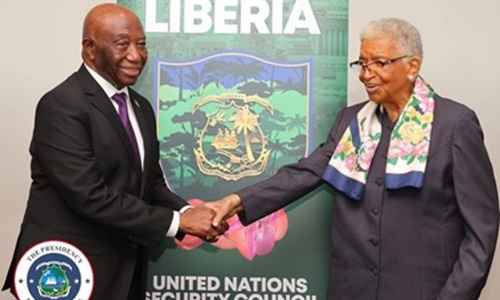
Former President Ellen Johnson Sirleaf has strongly warned the Unity Party government headed by Joseph Boakai to build strong integral business and not drugs empire. The Africa’s first female president warns that the nation risks becoming a haven for drug cartels unless it urgently builds a reputation rooted in integrity and trust.
Speaking at the opening of the National Conference on Women’s Financial Inclusion in Congo Town, Sirleaf declared that Liberia must shed its image as a magnet for criminal enterprises and instead cultivate confidence that attracts legitimate investors.
“We have to build confidence in all aspects of our national endeavors,” she said. “Otherwise, we might have those bad businesses like those drug people who are coming here. We have to build that confidence.”
“If you want more banks to open, if you want investment to come, they have to have confidence in our government a government that they must respect, a government that they can rely on, a government that has the reputation to attract them. Otherwise, you will have only the bad businesses, like these drug people who come here. So, we have to build that confidence. A government has to have that confidence to tell the people, ‘Come to Liberia, bring us your money, do your investment, do your business, make sure you get your return.’
“They will not bring their money, their business, for nothing. They will bring big money, but make sure that the country also has its fair share. And we, as people, must have confidence in our government that we can rely on them, on the government, to do the right thing.”
Her remarks come in the wake of a staggering scandal: the discovery of more than US$370 million worth of illicit drugs inside Liberia, a seizure that has rattled the nation and raised questions about the country’s porous borders and compromised institutions.
Sirleaf, who steered Liberia through post-war recovery and earned global respect as Africa’s first elected female head of state, emphasized that credibility is the cornerstone of economic growth. She insisted that banks, investors, and international partners will only engage with Liberia if its government demonstrates discipline, transparency, and accountability.
“Liberia needs a government that investors can trust and respect if it wants more banks and genuine investments,” she stressed, underscoring that the lure of quick profits from criminal networks is no substitute for sustainable development.
Her warning resonates at a time when public confidence in governance is fragile, and the specter of organized crime looms large. Analysts argue that the drug bust underscores systemic weaknesses in Liberia’s security and financial oversight, while citizens fear that unchecked corruption could entrench criminal syndicates at the heart of the economy.
Sirleaf’s intervention re frames the debate: Liberia’s future hinges not on short-term gains but on building a culture of integrity that repels illicit actors and welcomes credible investors. For a nation striving to rebuild its reputation, her message is clear — the choice is stark between becoming a hub for drug dealers or a beacon for legitimate business.
As the conference spotlighted women’s role in financial inclusion, Sirleaf’s words carried added weight: integrity is not just a political imperative, but a social contract that determines whether Liberia rises as a trusted partner or sinks into criminal capture.

