

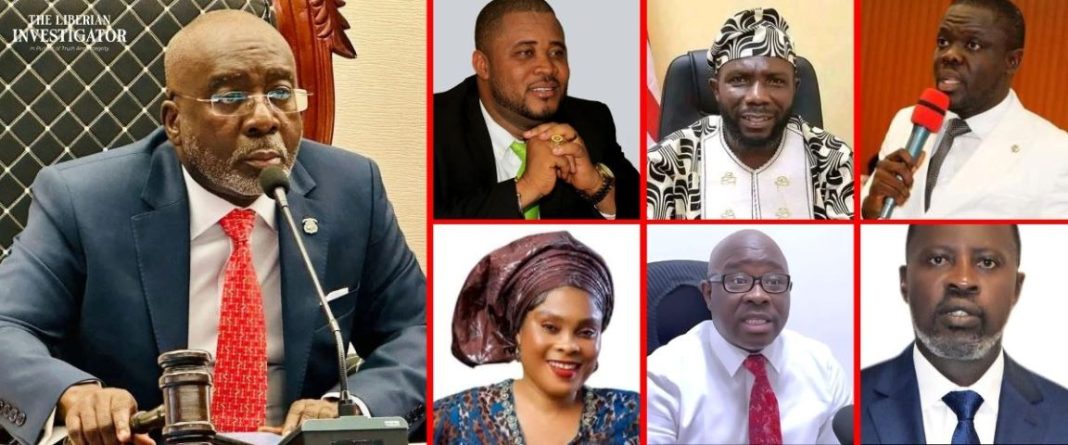
The Supreme Court of Liberia will today, August 28, hand down a pivotal ruling that will determine the legal fate of former House Speaker J. Fonati Koffa, Representatives Dixon Seboe, Abu Kamara, and several co-defendants accused in the arson attack that destroyed the Joint Chambers of the Liberian Legislature.
The case, one of the most politically charged in recent years, has drawn national attention not only for its dramatic allegations but also for the constitutional and evidentiary questions it raises. The ruling is expected to clarify whether the defendants will face full trial, be acquitted, or see charges dismissed — a decision that could reshape public confidence in Liberia’s judiciary.
Legal experts, speaking anonymously, highlight several pathways that could lead to acquittal, mistrial, or dismissal. Chief among them is the defense’s focus on gaps in forensic evidence. The prosecution’s case has been criticized for “glaring deficiencies,” particularly the absence of direct forensic links tying the accused to the crime scene.
During testimony, a Liberia National Police investigator admitted under oath that authorities failed to conduct fingerprint analysis on critical items allegedly used to ignite the fire — specifically a Clorox bottle and a matchbox found at the scene. This omission, the defense argues, undermines the credibility of the state’s case and creates reasonable doubt.
While the lower court previously ruled that circumstantial evidence was sufficient to establish a prima facie case, the defense insists that the higher standard required for conviction in Criminal Court “A” has not been met. Without forensic matching or direct physical evidence, they argue, the prosecution cannot prove guilt beyond a reasonable doubt. Should the Supreme Court agree, the defendants must legally be acquitted.
Another critical issue before the Court is the constitutional dispute surrounding jury management. Defense lawyers contend that trial judge Roosevelt Z. Willie acted unconstitutionally by removing a seated juror based on alleged political affiliations and later attempting to disband the entire jury panel.
This maneuver, they argue, violates due process and raises serious constitutional concerns. If the Supreme Court rules that the jury was improperly dismissed, it could trigger protections against double jeopardy, barring retrial and potentially crippling the prosecution’s case.
Legal analysts warn that improper dismissal of a sworn jury could compromise the trial’s legitimacy.
A ruling in favor of the defense may not only lead to mistrial but also prevent the state from retrying the defendants under constitutional double jeopardy principles. Such an outcome would represent a significant victory for the defense and a major setback for the prosecution.
The defense has also argued that the charges are politically motivated, pointing to the timing of the fire, which occurred immediately after a contentious attempt to remove Koffa as Speaker. They claim the allegations are circumstantial fabrications designed to weaken Koffa’s political faction.
By framing the case as a politically weaponized prosecution, the defense seeks to dismantle the narrative of criminal intent and highlight broader concerns about judicial independence in Liberia.
Once the trial resumes, the defense retains the right to file a Motion for Judgment of Acquittal before jury deliberations. If the judge determines that the state’s case rests solely on political suspicion and unverified police links — without proof that Koffa and his co-defendants purchased or deployed explosives — the charges could be dismissed outright.
Today’s ruling will therefore serve as a decisive moment in Liberia’s judicial history. Whether the Supreme Court upholds the prosecution’s case or sides with the defense, the outcome will shape public perceptions of the judiciary’s independence, the rule of law, and the balance between politics and justice.
As the nation awaits the verdict, the stakes remain high. The decision will not only determine the future of Koffa and his co-defendants but also test Liberia’s commitment to constitutional safeguards and fair trial standards.

