

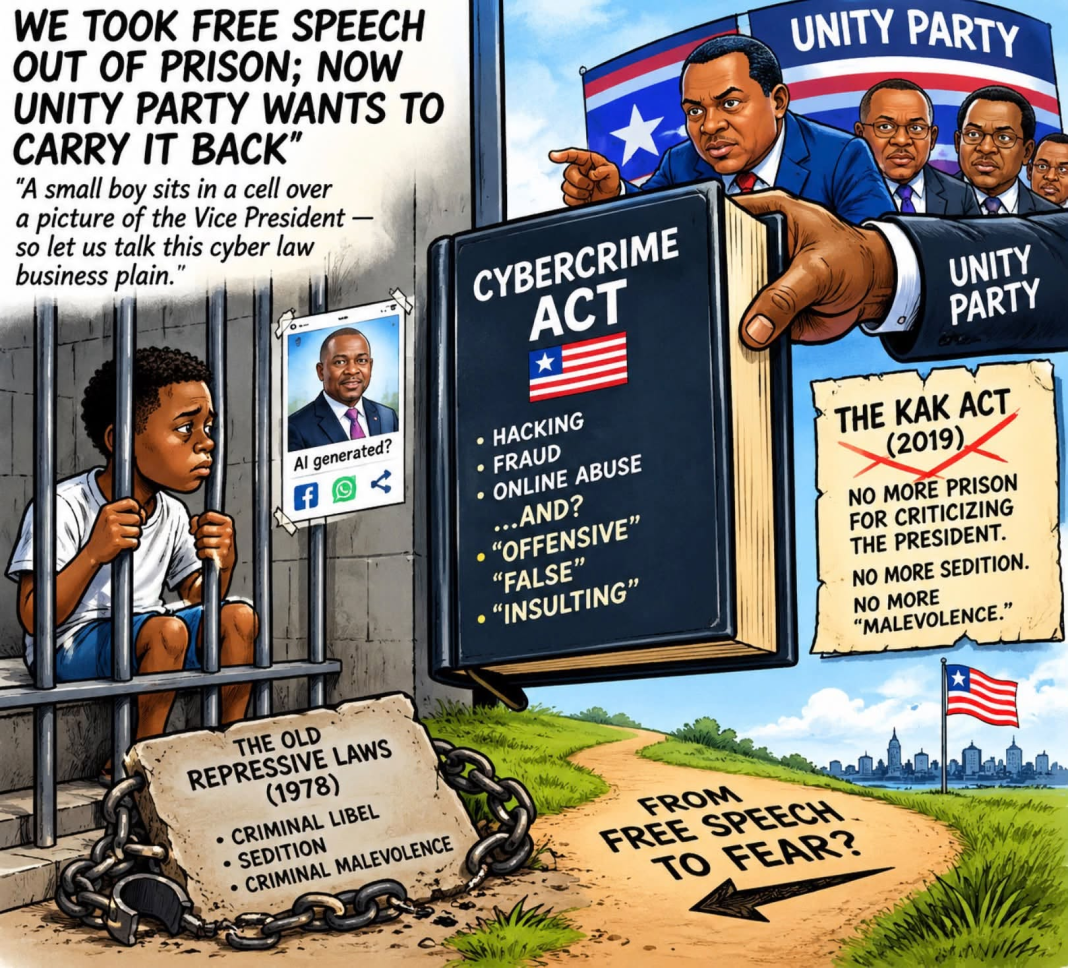
A small boy sits in a cell over a picture of the Vice President — so let us talk this cyber law business plain
Let me start with a small boy and a big law, because that is where this whole matter has landed. His name is Jerry Nyantee Wrotto, and the police have put him behind bars over some pictures and videos of Vice President Jeremiah Koung, said to be made by that artificial-intelligence business, that spread on Facebook after the talk about the Vice President’s screening at Brussels airport.
The charge? Liberia’s brand-new Cybercrime Act, the one President Boakai signed into law on the nineteenth of August this year. A boy in a cell for a picture. Hold that thought, because it tells you where we are headed.
REMEMBER WHERE WE WERE COMING FROM
To understand why this should worry every Liberian, you have to remember the road we walked to get here. In the old days — under that 1978 Penal Code — our law carried three heavy sticks that government used to beat down anybody who talked too much: criminal libel, sedition, and something they called criminal malevolence.
If you insulted the President, if you wrote something they did not like, the state did not argue with you. It arrested you. Journalists slept in cells for their pen, and everybody learned to mind their mouth.
Then in 2019 we did a fine thing, a thing the whole world clapped for. Through the Kamara Abdullah Kamara Act — the KAK Act, we all call it — Liberia threw those three sticks in the fire. No more prison for criticizing the President. No more sedition.
No more “malevolence.” We took free speech out of prison and set it in the open air, and we lined ourselves up with the big international promise, the Declaration of Table Mountain, that says a country should not use criminal law to punish what people say. For once, small Liberia was the example, not the embarrassment.
NOW SEE WHAT IS CREEPING BACK
Now here is the wahala. Just when we thought that fight was won, two things are quietly carrying the old fear back through the back door. First is this Cybercrime Act. Understand me well — a cyber law is not a bad thing in itself; a serious country needs law against hacking, against fraud, against the wicked people who put women’s nakedness online and steal people’s money through the phone. Nobody is quarreling with that part.
The trouble is the other part, the loose part, the sections that reach past crime and put their hand on plain talk — the vague words like “offensive” and “false” and “insulting” that can stretch to cover anybody the powerful want covered.
And second, right beside it, some people in the Legislature are trying to reopen the very KAK Act itself, through a new bill they dress up nicely as protection from online abuse against women.
The abuse of women online is real, and it is wicked, and I will come to that. But the Press Union has smelled the danger plain: once you crack open that law and slip criminal punishment for “insulting” speech back inside, that same loose net will not stay on the woman-abuser. It will drift, the way these things always drift, until it lands on the journalist and the ordinary citizen who vexed a big man.
A LOOSE LAW IS A DANGEROUS LAW
This is the part our lawmakers must hear, because it is the whole heart of the matter. A good cyber law and a bad one can look almost the same on paper; the difference is in how tight the words are tied. A good law goes after what a person does — the hacking, the real threat, the stolen identity, the fake nude picture made to shame somebody. A bad law goes after what a person thinks and says, and it does it with rubber words that the government can stretch to any size it needs on any given day.
Best practice everywhere — and even our own honest lawyers have said it — demands three things this Act is thin on: clear, tight definitions; a judge standing between the police and the citizen; and a sunset clause so the law is reviewed and not left to rot into a weapon.
We have seen this film before in this same West Africa. Pakistan passed such a law with a loose “false information” clause, and the next thing, journalists were in the street protesting a muzzle. A loose law does not stay loose in the government’s hand. It becomes a rope.
THE WROTTO CASE IS THE WARNING BELL
So, bring your eye back to that boy, Wrotto, in his cell. Whatever foolishness he did with those pictures, ask yourself the plain question: is a young man in prison the first thing this fine new law should show us? Not a hacker caught. Not a mobile-money thief jailed. Not a cartel’s cyber-network broken.
No — the first big catch is a boy who took a mocking picture of the Vice President. That, my people, is exactly the fear the KAK Act was built to end: the state using its law not on the criminal, but on the critic.
And here is the twist that should make everybody stop and think. Vice President Koung himself — the very man in the pictures, and, as President of the Senate, the presiding officer of the same chamber that passed this Cybercrime Act — has turned around and asked the police to release the boy.
When even the offended big man is saying, “let him go,” that is the government being handed a chance to prove which kind of law we got: a shield for the weak, or a muzzle for the bold. Let them not waste that chance.
PROTECT THE WOMAN, DO NOT MUZZLE THE NATION
Now let me be fair and plain, because I do not want any big man to twist my words tomorrow. The online abuse of women in this country is a real disease — the insults, the shared nakedness, the threats that make a woman fear her own phone. And our Supreme Court was not wrong when it said, in that Prophet Key matter, that free speech does not mean the freedom to pour vulgarity and describe a woman’s private parts on Facebook.
Nobody with sense is defending that. But you do not cure that disease by swallowing the poison of criminal-speech law all over again. You write a tight, standalone law that punishes the real harm — the non-consensual picture, the true threat — and leaves plain criticism and rough political talk alone. Protect the woman with a scalpel; do not swing a cutlass over the whole nation’s mouth.
A WORD TO THE UNITY PARTY, AND TO US ALL
To the Unity Party government, which signed this law and under whose watch the boy now sits, the responsibility is yours to carry: you are the ones enforcing it, so you are the ones the history will name if the muzzle goes back on.
And let me be even-handed — this foolishness is not one party’s alone; the folly of loose speech-law has friends on every side of our politics, and even opposition voices who cheered such laws yesterday are only now, when the shoe pinches, discovering the danger. So, this is a warning for the whole political class, but the government holds the pen and the key today.
We fought too hard, and buried too much, to take free speech out of prison in 2019, only to let it be marched quietly back inside in 2026 wearing a computer for a disguise. Tie the loose words. Put the judge in the room.
Protect our women properly and separately. Free the boy or charge him under a fair and narrow law. And let no government forget the oldest truth of our young democracy: a people who fear to talk are not a safe people — they are only a silent one, waiting.

