

By Sidiki Fofana/ Truth In Ink
When a young woman is threatened online, her private photographs circulated, and strangers invited to find her home, the harm is real. When a journalist questions a minister’s spending and the minister calls the criticism “cyberbullying,” the danger is real too. A society that takes either danger lightly will eventually make room for both.
The argument over online speech is often presented as a choice between protecting people and protecting freedom. That framing serves whoever wants an easy answer. The harder question is this: Who benefits from the rule, who has the power to enforce it, and whose voice disappears when it is applied?
There is a strong case for action against cyberbullying. An anonymous account can follow a child home from school, recruit a crowd in minutes, or distribute intimate images long after the victim asks for them to be removed. Targets may be driven away from school, work, public debate, and the internet itself. UNICEF describes both the harm and the unfairness of expecting victims to abandon online spaces.
Women, young people, and those with less money or political influence often have fewer ways to protect themselves. A right to speak means little when threats and organized abuse make it dangerous to exercise that right.
Effective protection benefits the person receiving threats. It benefits parents trying to keep children safe. It benefits women in public life who should be able to argue without facing sexual intimidation.
It benefits journalists whose reporting attracts coordinated harassment. Platforms should provide usable reporting and appeal systems; investigators should be able to respond to credible threats, stalking, impersonation, and the nonconsensual circulation of intimate images. Victims need timely help, preservation of evidence, and meaningful remedies.
There is also a strong case for caution. “Cyberbullying” is a broad social description. In political hands, it can become a convenient accusation against someone whose words are merely sharp, embarrassing, or persistent. Who decides when criticism crosses the line: the person criticized, a political appointee, a police officer, or an independent court? A president’s wounded pride cannot be the measure of a citizen’s freedom.
Imagine a citizen posting documents that raise questions about a government contract. Supporters of the official flood the citizen’s account with threats. The official then files a complaint claiming that the citizen’s repeated posts amount to bullying.
If authorities investigate the critic while ignoring the threatening crowd, the promised protection has changed hands. The person with power receives a shield; the person demanding accountability receives a warning.
Liberia has particular reason to recognize this danger. Article 15 of the Constitution protects freedom of expression, includes freedom of the press, and safeguards the public’s right to information about government and its functionaries. It also speaks of responsibility for abuse and identifies judicial processes for certain limits. Those words require careful judgment. They do not give politicians ownership of the national conversation.
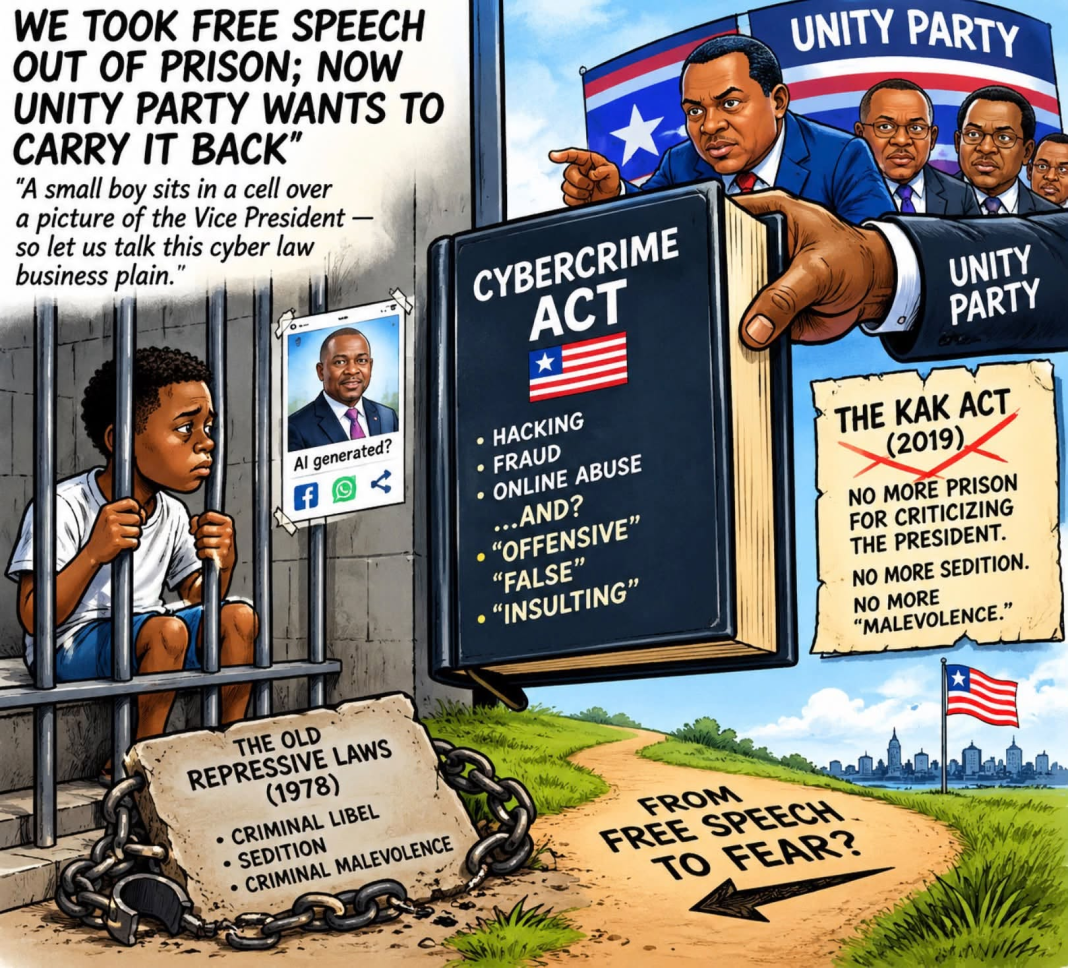
Our recent history gives that judgment weight. In 2019, Liberia’s Kamara Abdullah Kamara Act of Press Freedom repealed the penal provisions on criminal libel against the president, sedition, and criminal malevolence. That was a deliberate move away from treating criticism of power as a crime.
A loosely worded online-harassment measure could recreate the same fear under a more sympathetic name. The arrest, the seized phone, and the cost of defending oneself can chill speech even when a case goes nowhere.
The political incentives are plain. An incumbent may praise free speech while in opposition and discover “abuse” in every difficult question after taking office. An opposition leader may denounce censorship while quietly welcoming online mobs that intimidate rivals. Private platforms also gain enormous discretion when governments ask them to remove “harmful” material without clear standards or appeals. In each case, the public loses the ability to know which decisions protect a victim, and which protect a reputation.
This does not mean public figures surrender their safety. A threat against a minister or an opposition activist should be assessed with the same seriousness as a threat against anyone else. Public office does, however, invite more scrutiny.
The African Commission on Human and Peoples’ Rights says public figures must tolerate a greater degree of criticism. Its principles call for restrictions on expression to be clear, necessary, proportionate, independently overseen, and open to appeal. That is a standard worth applying to any proposal made in the name of online safety.
So, draw the line in the conduct and the harm. Identify threats, stalking, impersonation, and intimate-image abuse precisely. Require evidence and independent review before punitive action.
Publish enforcement figures so citizens can see whether ordinary victims receive help or political complaints dominate the docket. Give people a way to contest mistaken removals. Protect investigation, satire, unpopular opinion, and forceful criticism of public officials. Make those protections real for government supporters and opponents alike.
Who benefits? Under a fair system, the threatened citizen benefits, the honest journalist benefits, and even the criticized official benefits from a public debate with clearer rules. Under a vague system, whoever controls the complaint process benefits most.
Liberia should be able to protect a child from a digital mob without teaching an adult to fear questioning a minister. The test of any proposed rule is what happens when its target is the person with the least power and when its complainant is the person with the most. If the rule cannot pass both tests, it protects authority more reliably than it protects people.

