

By Sherman C. Seequeh
…They promised that after one hundred days no car would sit in the mud. Open Facebook right now and count the cost of that promise.
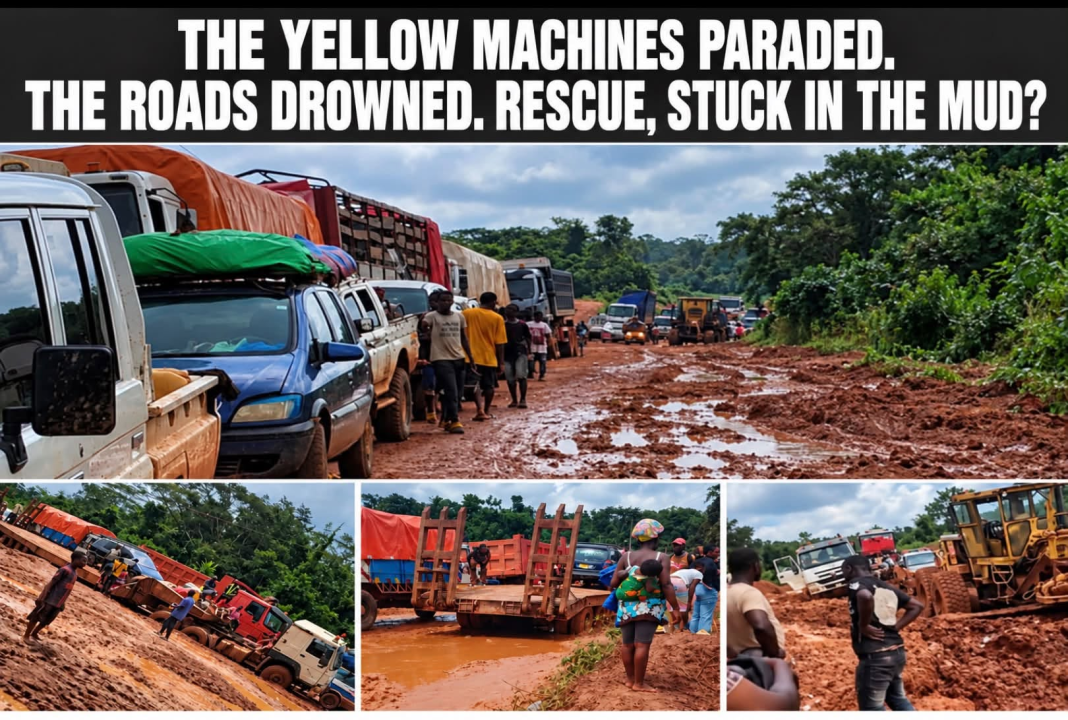
Open any Liberian Facebook page right now and brace yourself. Almost all timelines are drowning — swamped with footage no citizen should ever have to watch about his own country. Muddy scenes without end. Swarms of vehicles sunk to their axles in mountains of mud.
Women and children marooned in the middle of the highway, their loads on their heads and the night coming down fast. Young men who set out that morning as fellow travelers now brawling in the muck over some petty argument born of pure exhaustion. From county to county, from city to city, to travel in Liberia today is to enter a season of suffering.
And remember — remember well — who promised us otherwise. This is the administration that rode to power on the sweet platitudes of “rescue,” and that made, among its most notorious vows, this one: that after 100 days in office, no car would be left stuck in the mud anywhere in this country. 100 days. Look now at the scenes. Our people are weeping in the forests, deep on the highways, where no camera from Monrovia ever bothers to go.
And who can forget the boasting? Senator Zoe Emmanuel Pennue of Grand Gedeh — one of that belly-driven breed who ride the government convoys and seldom feel the people’s potholes — went so far, in a throwback clip Liberians are now passing hand to hand, as to stake his very seat on the matter. “If their car gets stuck,” he declared, “let them tell me. I will resign as Senator of Grand Gedeh County.” He said it. On camera. Let the man who kept that footage guard it well.
This is the same senator who, in that calmer season when a vehicle could still crawl along our laterite roads, was fond of assuring us that a citizen could dress head to toe in spotless white, travel all the way to Grand Gedeh, and never once fret about a mud stain. White clothes, he said, on a southeastern road. Frankly speaking, let him make that journey this week.
Let him put on his white gown this very morning and set out for Zwedru, or for Kpelleh Village along the Nimba–Grand Gedeh corridor. He would come home the color of the red clay — if, given the state of those roads, he came home at all. And as for the resignation he staked on it? The cars are stuck in the mud tonight, Honorable — from Grand Gedeh to River Gee, stuck fast to the axle. We are telling you. Now, about that promise.
THE PROMISE, WORD FOR WORD
Let us not argue from feeling; let us argue from the record. The promise was not loose campaign noise. When the new government took office, it unveiled a 100-day action plan whose flagship was the roads — 11 priority projects, some 783 kilometers of them, strung across 12 major corridors. For the first 100 days alone, the plan earmarked US$23.5 million to make our primary roads passable in every season.
But here is where the promise began to sink. By the Ministry of Public Works’ own accounting, of that US$23.5 million, barely US$8.9 million was ever remitted by the Ministry of Finance. A pledge budgeted at over US$23 million was quietly watered down to less than US$9 million — and that, mind you, before the first heavy rains had even fallen. More often than not, that is how a Liberian promise dies: not in a loud announcement, but in the silence between what was budgeted and what was released.
WHAT THE SPEECHES SAY, AND WHAT THE MUD SAYS
To be fair, the government does not lack for figures. Finance Minister Augustine Ngafuan boasts that Liberia now commits nearly a quarter — some 25 percent — of its public investment budget to roads. The national budget itself has swollen to around US$1.2 billion. The National Road Fund, we are told, has been reformed for transparency and steady financing. On paper, the money is marching.
Now hear the other side of the case — and hear it from no oppositionist, but from a son of the very southeast that is drowning tonight. Senator Albert Chie of Grand Kru stood on the floor of the Senate and laid the bitter arithmetic before the nation: Liberia needs about US$7 billion to pave the 11,788 kilometers of road that remain in the dirt.
As of the close of 2024, he reminded us, only 1,212 kilometers out of some 13,000 had ever been paved. 1,212. Given the fact that we crawl forward at this pace, the grandchildren of the market woman stranded on that highway tonight will still be pushing their motorbikes through the very same mud.
THE YELLOW MACHINES THAT PARADED, THEN PARKED
Ah, but the government had a grand answer ready — the famous “yellow machines.” 285 earth-moving machines, we were told, would roar into our counties and bury the bad-road nightmare forever. And when the first batch of 137 of them landed, they were driven in a gleaming convoy through the streets of Monrovia, yellow and shining for the cameras, then parked in neat rows at the BTC Barracks. It was a fine show. Critics called it exactly what it was — grandstanding.
The trouble is everything the show did not reveal. The machines were first priced at US$79 million, then said to be renegotiated down to around US$22 million over 3 years — but to this day the government has never fully disclosed the true figure or the full terms. No open, competitive bidding anyone can point to.
The Public Procurement and Concessions Commission brushed aside. The Legislature bypassed. The whole thing, the administration itself admitted, rested on a “gentleman’s agreement” with a South African billionaire described as a friend of the President. Even the President, in his own letter to the Legislature, conceded that “errors” had been made.
As I see it, that word — errors — is doing a great deal of heavy lifting. John Morlu, this nation’s former Auditor General, put it plainer than any of us could: “Government cannot be done on friendship,” he said. “This is simple Accounting 101.” In as much as some of the harsher charges of outright fraud remain allegations yet to be proven, this much is beyond argument: a people were made to watch a parade of yellow machines in the capital while the roads that cried out for them sat drowning five hundred miles away.
THE SCENE THE CONVOY WILL NEVER SEE
So let me end not with a figure, but with a face — the kind of face that never trends on Facebook, because there is no network signal that deep in the bush.
Somewhere in the deep southeast tonight, under this same unending rain, a woman has gone into labor. There is no ambulance for her, because there is no road for an ambulance to travel.
So her people do the only thing our people have always done: they lay her in a hammock, lash it to a pole, and six tired men lift her onto their shoulders and begin to walk — sloshing, slipping, praying — through mud that swallows them to the knee, toward a clinic that is hours away on foot and would be twenty short minutes by car, if only a car could pass. No yellow machine will reach her road tonight. No senator in white will ever ride it. No hundred-day plan ever found her village on its map.
That woman, my people, is the real budget line. That child — born safely in the mud tonight, or lost in it — is the true report card of this Rescue. And until the machines roll out of the barracks and the money walks out of the speeches, and both finally arrive where our people are weeping in the forest, let no one sitting dry in Monrovia dare tell us the roads are fine. Not even in white.

