

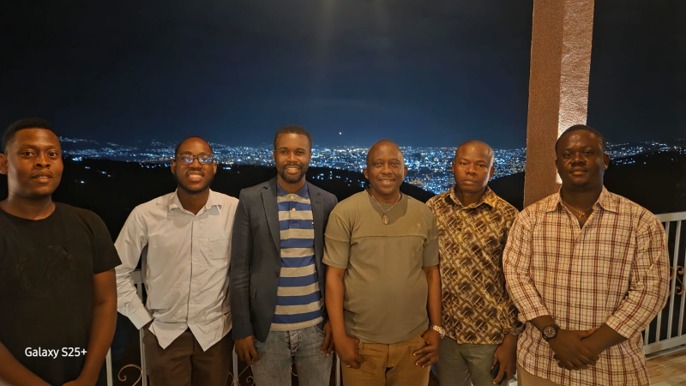
A high-level Liberian delegation has concluded a study tour of Rwanda’s transitional justice institutions, marking another step in Liberia’s efforts to establish the War and Economic Crimes Court (WECC) and the proposed National Anti-Corruption Court (NACC).
The delegation returned to Liberia on Monday, October 12, following an intensive mission organized by the Office for the Establishment of the War and Economic Crimes Court for Liberia (OWECC-L) and the Press Union of Liberia (PUL).
The visit, which ran from September 24 to October 12, provided participants with firsthand exposure to Rwanda’s post-conflict justice mechanisms, memorialization initiatives, media institutions, and national reconciliation programs. The delegation visited Kigali, Musanze, Rubavu, Kibuye, and Nyanza, engaging a broad range of stakeholders involved in Rwanda’s recovery and accountability processes.
According to OWECC-L and the PUL, the study tour was designed to strengthen Liberia’s ongoing transitional justice agenda through institutional learning, knowledge exchange, and collaborative partnerships.
During a series of meetings with government officials, civil society actors, media organizations, and memorial centers, discussions focused on Rwanda’s experience in addressing the legacy of conflict while promoting national healing, reconciliation, and accountability.
Speaking during engagements with Rwandan stakeholders, OWECC-L Executive Director, Dr. Cllr. Jallah A. Barbu, and PUL President Julius Kanubah emphasized the importance of international cooperation and technical exchanges in supporting Liberia’s pursuit of justice and accountability.
The two officials highlighted the need for institutional capacity building in areas such as reconciliation, memorialization, digital archiving, victim support, and the prosecution of serious human rights abuses and economic crimes.
The delegation noted that Rwanda’s experience offers important lessons for Liberia as it seeks to confront the legacy of its civil wars while strengthening public trust in state institutions and advancing accountability for past atrocities.
Media development and professional collaboration also featured prominently during the visit. Given Rwanda’s unique media history, including its role during the 1994 Genocide against the Tutsi and its subsequent contribution to national recovery and reconciliation, delegates explored ways to strengthen responsible journalism and public education on transitional justice issues.
The Liberian delegation held strategic discussions with the Rwandan Journalists Association (ARJ), the Rwanda Media Commission (RMC), and the Liberian Media Institutions Network-Rwanda (LMIN-R), a network of online media platforms operated by Liberian students, journalists, and media practitioners residing in Rwanda.
OWECC-L and the PUL expressed optimism that the engagements would lead to practical partnerships in transitional justice reporting, media capacity development, digital documentation, peace education, and professional exchanges between journalists and justice sector actors in both countries.
The institutions further stated that prospective collaborations would complement existing partnerships and contribute to strengthening democratic accountability, professional solidarity, and public awareness efforts in Liberia and Rwanda.
The delegation comprised Dr. Cllr. Jallah A. Barbu, Executive Director of OWECC-L; Julius Kanubah, President of the Press Union of Liberia; Ezekiel E. Fayia, Liberia National Police intelligence and investigative officer assigned to OWECC-L; Simeon J. Lomah, Head of ICT at OWECC-L; Edmond S. Kamei, Assistant Director for Operations at OWECC-L; and Patrick Niyongabo, advisor and escort for the Rwanda engagements.
The mission also benefited from the support of Tyfred B. Teh, a Liberian Master of Laws (LL.M.) student in Rwanda and member of the Steering Committee of the African Transitional Justice Youth Network, who assisted and participated in several engagements throughout the visit.
The study tour is expected to inform Liberia’s continuing efforts to establish credible accountability mechanisms aimed at addressing past war-related and economic crimes while promoting national reconciliation and the rule of law.

