

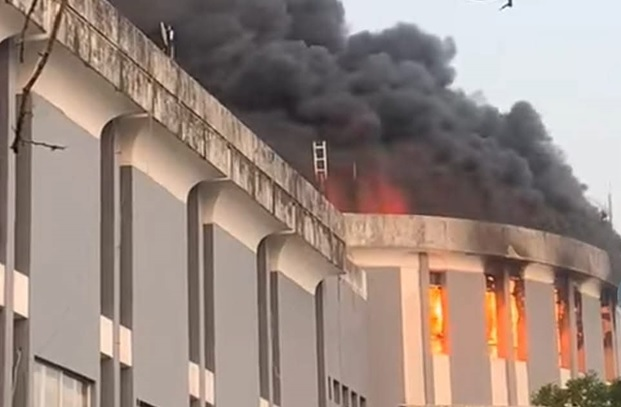
In Criminal Court “A” on Wednesday, Chief Criminal Investigator Raphael Wilson, the prosecution’s principal witness in the trial arising from the December 2024 fire at the Capitol Building, acknowledged that physical items presented by the state as alleged arson instruments carry no forensic fingerprints tying them to the accused.
The admission intensified defense challenges over the reliability of the state’s case and exposed broader questions about expert evidence, chain of custody and the admissibility of material allegedly connected to coerced confessions.
Judge Roosevelt Z. Willie repeatedly overruled defense objections, however, allowing Wilson to continue testifying and permitting the prosecution to present audio recordings to the jury.
The judge described Wilson as an investigator rather than an expert in voice analysis but ruled that the materials could be admitted showing that statements were made — not to prove the truth of every assertion contained on the recordings.
What was said in court
Wilson told the court that the items introduced as alleged arson instruments — a small matchbox and a Clorox bottle said to have contained fuel — yielded no fingerprints attributable to the defendants.
He said it was “impossible” to recover prints from the Clorox bottle and matchbox as submitted.
The witness also conceded there is no CCTV footage in evidence linking the defendants to the scene.
Defense counsel further highlighted inconsistencies between earlier descriptions of exhibits and what was produced at trial: a matchbox previously described in magisterial court as three inches long was produced as a much smaller box, and a container initially described as a mayonnaise jar was later presented as a Clorox bottle.
Counsel objected to Wilson’s interpretation of audio recordings and to his capacity to identify voices, arguing he is not a specialist in forensic voice analysis.
Judge Willie said police had requested a search warrant, lacked in-house expertise and had enlisted assistance from the National Security Agency.
The Judge Willie allowed the recordings to be marked and played for the jury, saying the court will treat such hearsay material as evidence that a statement was made, without endorsing its substantive truth.
Defense teams also objected to about nine items of documentary evidence, including a special investigative team report they say was not disclosed in discovery.
The defense further alleged that several charge sheets and statements that produced indictments were obtained through coercion and torture during interrogations by the Liberian National Police and the National Security Agency.
The judge overruled most objections and the testimony continued.
In September Court-ordered medical examination of six men accused of arson revealed evidence of severe torture, leading to grave medical conditions including disfigurement, vision loss, and psychological distress.
The accused have alleged that members of the Liberian National Police and the National Security Agency subjected them to inhumane treatment to extract confessions and implicate then Speaker of the House J. Fonati Koffa in the arson case.
They narrated being coerced into providing false testimony under extreme physical and psychological pressure.
The admissibility of the evidence obtained from these alleged torture victims has become a pivotal issue in the case.
Judge Willie ordered the medical examinations, which were conducted in accordance with the Istanbul Protocol, a UN manual for the effective investigation and documentation of torture.
Dr. Philip Zochonis Ireland, an Assistant Professor of Internal Medicine at the University of Liberia, conducted the examinations at the AMI Expeditionary Healthcare Medical Center.

