

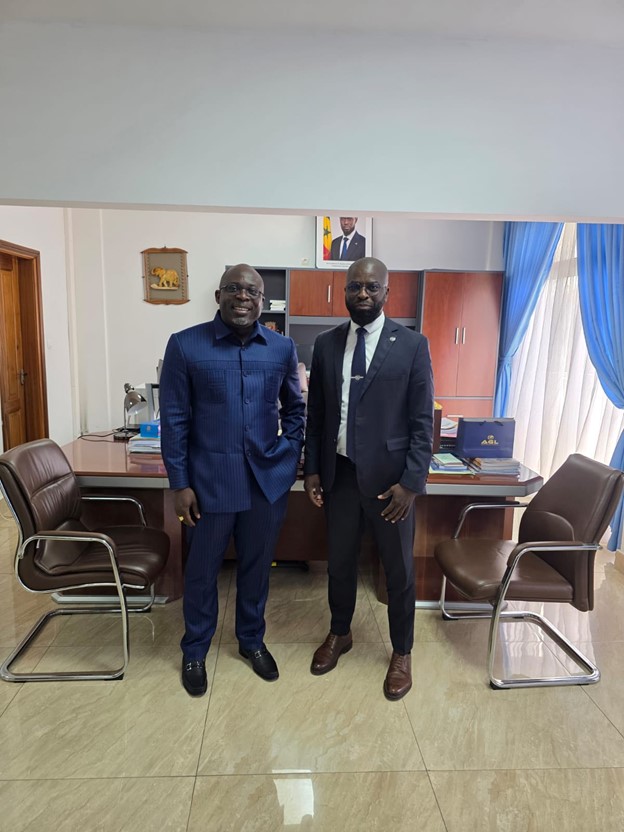
Liberia and Senegal are advancing plans to formalize a strategic maritime partnership, following high-level talks between the Liberia Maritime Authority (LiMA) and Senegal’s National Agency of Maritime Affairs (ANAM). The discussions, held in Dakar, mark a significant step toward strengthening cooperation in maritime governance, infrastructure, and training across West Africa.
The Liberian delegation, led by LiMA Commissioner and Chief Executive Officer Neto Zarzar Lighe Sr., met with ANAM Director General Becaye Diop to negotiate a Memorandum of Understanding (MOU). The proposed agreement will serve as a framework for collaboration in areas including inland waterways transport, maritime education, ship inspection, digitalization, and enforcement against illegal, unreported, and unregulated (IUU) fishing.
Diop welcomed the Liberian officials and underscored Senegal’s commitment to building a durable partnership. He highlighted Liberia’s global standing as operator of the world’s largest ship registry, noting that Senegal’s domestic maritime development could benefit from Liberia’s international expertise.
The Senegalese maritime chief also disclosed his country’s intention to contest for Category C membership of the International Maritime Organization (IMO) Council in the November 2027 elections. He appealed for Liberia’s support, stressing that stronger African representation at the IMO is vital to amplifying the continent’s voice in global maritime governance.
Commissioner Lighe reaffirmed Liberia’s readiness to deepen cooperation, emphasizing that while Liberia holds a Category A seat on the IMO Council, there is much to learn from Senegal’s progress in inland waterways and ferry transport. “Our engagement with Senegal represents an important opportunity for mutual learning and institutional collaboration,” Lighe said.
“Liberia brings experience in international maritime administration, while Senegal has made notable progress in domestic maritime infrastructure. Together, we can build stronger institutions that benefit both countries and the African continent.”
Liberia outlined several modernization initiatives currently underway, including construction of a new executive annex at LiMA, expansion of digital infrastructure, establishment of a digital library and IT center, and upgrades to the Maritime Rescue Coordination Center. Plans also include acquiring additional patrol boats to bolster maritime security. Liberia stressed its commitment to compliance with the International Ship and Port Facility Security Code (ISPS Code) and ongoing collaboration with the United States Coast Guard to enhance training and operational capacity.
Senegal, in turn, presented its own ambitious maritime development agenda. Key projects include construction of new port facilities, expansion of maritime training institutions, and introduction of eco-friendly ferry services to improve coastal and island connectivity. The country also highlighted a 49 billion CFA agreement with the Netherlands to support port development and maritime education, alongside plans to modernize the Gorée Island ferry terminal and expand passenger ferry services to stimulate economic activity.
Both sides agreed that the proposed MOU will provide a structured framework for technical cooperation, enabling exchange of expertise in maritime safety, digitalization, and institutional strengthening. The agreement is expected to undergo internal review in Senegal before being finalized, with an official signing ceremony anticipated in Monrovia.
Beyond bilateral cooperation, the talks also reflected a broader push for African solidarity in maritime affairs. Liberia pledged support for Senegal’s IMO Council bid, stressing that continental collaboration is essential to ensuring Africa’s interests are represented in international decision-making.
As part of the visit, the Liberian delegation will conduct technical site tours of Senegalese maritime facilities, including ports, shipyards, ferry terminals, and the Maritime Rescue Coordination Center. These visits are designed to deepen knowledge exchange and provide practical insights into Senegal’s infrastructure development.
The partnership, once formalized, is expected to strengthen maritime governance, promote capacity building, and enhance regional cooperation within Africa’s maritime sector. Analysts say the collaboration could serve as a model for other African nations seeking to balance global maritime engagement with domestic sector development.

