

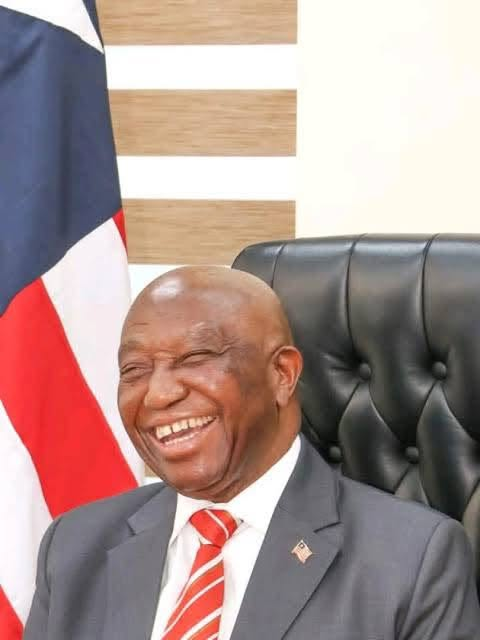
By Sherman C. Seequeh (A Liberian Journalist and writer)
There is a kind of trouble that arrives by accident, and there is a kind that arrives by appointment. Liberia is watching the second kind.
Joseph Nyuma Boakai and his Unity Party came to power carrying the drug question like a torch. They held it over the ruins of the Freeport case and told this nation that the men before them had opened the country to poison. They did not merely campaign on it. They preached it. And they did not stop at the truth of the thing. They made the Congress for Democratic Change the author of a national curse rather than the custodian of a national failure, and they swore the poison had come with those men and would leave when they left.
That was the lie. Not the crisis — the crisis was real, and the Freeport acquittal was a real disgrace. The lie was the claim of ownership: that this affliction belonged to one set of men, and that its cure was simply their removal. On that lie President Boakai and the Unity Party were carried into office. And it is on that lie that the account is now being settled.
For there is only one honest way to explain what Liberians are now watching: a drug pandemic spreading faster than at any time in our memory, and a government that seems trapped in it, turning in circles, unable to name a financier or close a case. Either the lie these men told is fighting back — the oath returning upon the mouths that swore it — or Providence is holding them to the sin and will not let them look away from it. Whichever a reader prefers, the shape is the same. They are caught in the exact thing they promised to end, and the harder they twist, the tighter it holds.
Consider the order in which it has come. On the eighth of June, two hundred and thirty-seven kilograms of cocaine at Roberts International Airport — nineteen million dollars, moving out through a cargo system this government administers, screened by officers it employs, cleared on documents its own hand approved. On the twenty-first of July, Duazon: three thousand nine hundred and seventy-one kilograms, three hundred and seventeen million dollars by the government’s own published figure, the largest narcotics seizure in the history of this Republic.
And the police now price the network behind it at four hundred million. Nineteen million to four hundred million in six weeks. The floodgate they swore to close has opened wider under their hand than it ever stood under the hand of the men they condemned.
Then mark the detail they handed us themselves. The Attorney General says the network may have been operating here for more than six years. Six years. Which means that while these men stood on platforms across fifteen counties swearing the poison would depart with George Weah, the cartel was already among us — settling, buying, building the very warehouse at Duazon. They were not deceived by a hidden thing. They were hired to end a thing they had located, named and measured. It did not leave with the last man. It has multiplied under this one.
And the affliction is no longer at the border. It is inside the house.
The Inspector General of Police has announced that Colonel Johnny Dean, Deputy Commissioner for Crime Services — the officer commanding the very division that investigates crime in this Republic — has been relieved of duty and rendered inactive of all policing roles after allegedly admitting he received ten thousand United States dollars in connection with suspects held in the largest cocaine case in our history.
Coleman was careful to add that Dean is not accused of trafficking. Mark how little that defends. The charge is not that the chief of crime services carried the powder; it is that money out of that world reached him. A trafficker can be arrested. A bought investigator is the arrest itself failing.
Nor does Dean stand alone. Two officers of the National Security Agency sit in detention. The names of senior police commanders are put up on screens before audiences of thousands every night in Monrovia while the country asks aloud how deep the rot has gone.
And let no one offer me the consolation that this proves the system works. When a police service must strip the head of its own crime services division in the middle of its largest case, that is not a demonstration of health. It is a confession about the condition of the house. A man is not congratulated for cutting off his own hand; he is asked how the gangrene got in, and how long he walked about knowing it was there.
So the question stands before them, plain and unanswerable: how does a government elected to end this trade find the trade flourishing in its warehouses and its own officers in its dock? And observe what they offer in reply — for the reply is itself part of the judgment. When Duazon broke, the ruling party did not stand before the nation and explain the corridor. It announced that the raid had occurred near the residence of Senator Nathaniel McGill. Not evidence. Geography.
And geography that proves nothing at all, since officials of that same government sleep along that same road. It was never built to prove. It was built to convert a question about the integrity of the Liberian state into a quarrel between two men. If it is further true that an image has been circulated placing one of the arrested foreigners beside former President Weah, then the same hand that reached for a street address has reached for a forgery.
There is the sign, for anyone who requires one. A government that came in on a lie about the drug question, caught by the drug question, reaching once more for a lie about the drug question. This is why the way out keeps closing on them. They deflected onto Bundoo and Tweah, and Duazon came. They deflected onto McGill’s address, and the police’s own broadcast contradicted them within the day.
They will deflect again, and the next seizure will come — for the way out of a labyrinth is never found by running faster, but by going back to where you first turned wrong. And they cannot go back. To go back is to confess what they said about the men they replaced, and what they knew when they said it.
Let me be precise, because the point deserves no softening. I do not say Providence has sent cocaine into Liberia to embarrass a political party. Our children are dying of this poison, and no honest man calls their dying an instrument of anyone’s vindication. What I say is this: when men take a genuine national wound and swear a false oath upon it, when they convert the agony of Liberian mothers into ballots, that oath does not expire on inauguration day. It waits. And it is answered in the same coin, in the same matter, before the same witnesses. They asked to be judged by the drug question. The prayer has been granted.
And let no one tell me this is merely how Liberian governments behave. Other governments failed at this; this one campaigned on the failure. Other governments were caught by the trade; this one was hired to end it. A man who takes wages by slandering the last workman, and then performs worse than the man he slandered, is something our language has a word for that I will let the reader supply.
They said the men before them were a curse upon Liberia.
They should have been more careful what they invoked. The invocation has been answered — and it has come home to the ones who made it.

